
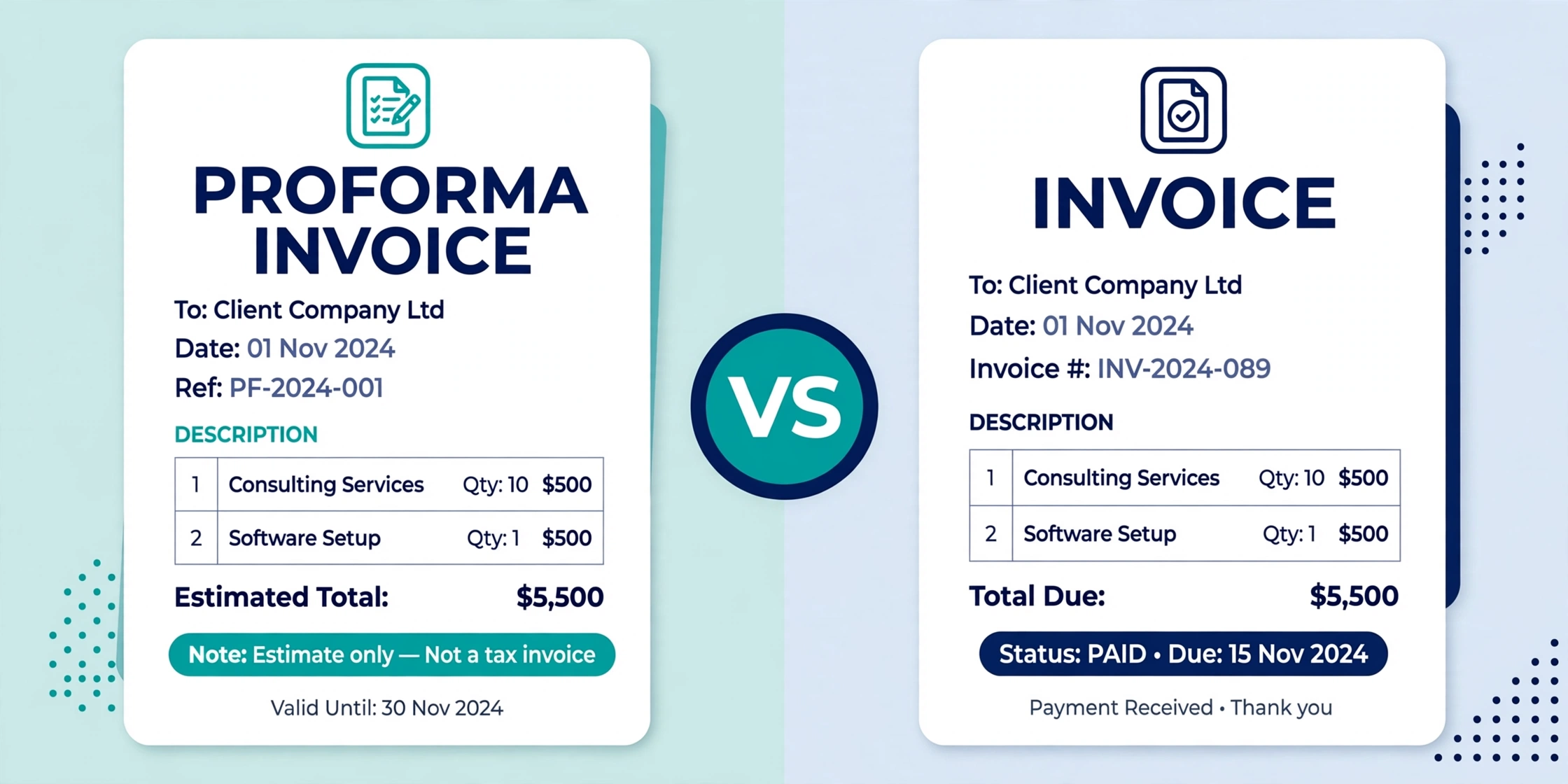
Your supplier emails you a “proforma invoice” and asks for payment. Is this the real bill? Can you pay it? Will it count for your taxes?
If you have ever stared at one of these documents and felt confused, you are not alone. Small business owners and freelancers run into proforma invoices all the time — especially when buying from abroad or working with new clients. A proforma invoice looks almost exactly like a normal invoice, and the two even share most of the same fields — but they work very differently.
In this guide, I will explain the difference between a proforma invoice and a regular invoice in plain English. You will learn when to send each one, what mistakes to avoid, and how to turn a proforma into a final invoice without any mess.
What Is a Proforma Invoice?
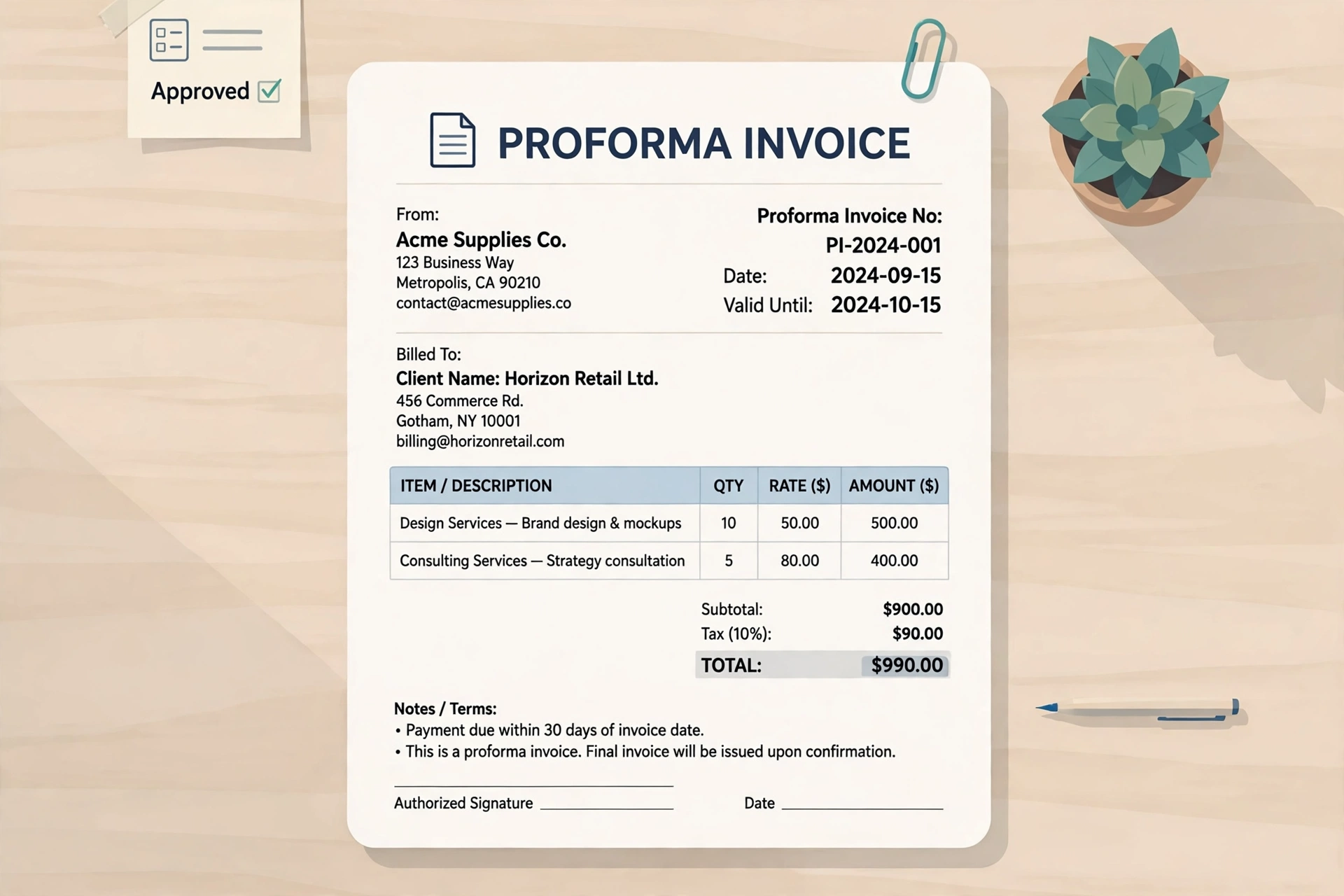
A proforma invoice is a preliminary bill. You send it before you deliver the goods or finish the work. It tells the buyer: “Here is what you will pay, and here is what you will get.”
The word “proforma” comes from Latin. It means “as a matter of form” — in other words, the document follows the form of an invoice, but it is not a real invoice yet.
Businesses use proforma invoices to:
- Give a buyer a firm, detailed price before the deal is final
- Get payment approval inside the buyer’s company
- Handle customs paperwork in international trade
- Ask for an advance payment or deposit before starting work
Think of it as a serious promise: “This is the deal.” But it is not a demand for payment yet — and it is not a tax document.
What Is a Regular Invoice?
A regular invoice — sometimes called a final invoice or tax invoice — is the real bill. You send it after you deliver the goods or complete the service.
It says: “I have done the work. Now you owe me this amount.”
A regular invoice:
- Creates a legal obligation for the buyer to pay
- Is recorded in your accounting books
- Is used for tax and VAT/GST purposes
- Starts your payment terms (like Net 30)
And note: an invoice is not the same as a receipt. A receipt only confirms that payment already happened — see our full breakdown of invoice vs receipt if you mix these two up.
Short version: the invoice is the bill that counts.
Proforma Invoice vs Invoice: The Key Differences
Here is the full comparison at a glance:
| Proforma Invoice | Regular Invoice | |
|---|---|---|
| Purpose | Shows expected costs before delivery | Bills the buyer for delivered goods or services |
| When it is sent | Before delivery or payment | After delivery or completion |
| Legal status | Not a legal tax document | A legal accounting document |
| Payment | Can request an advance payment | Demands payment per the agreed terms |
| Tax and VAT | Cannot be used to claim VAT/GST | Used for tax records and VAT/GST claims |
| Can you change it? | Yes — it is a draft of the deal | Only through a credit note after issuing |
| Numbering | Use a separate reference series | Must follow your official invoice number sequence |
When Should You Send a Proforma Invoice?
1. You are dealing with a new customer.
A proforma shows exactly what they will get and what it will cost. It builds trust before money changes hands.
2. You ship goods internationally.
Customs officers in many countries ask for a proforma invoice to check the shipment’s value. This is one of its most common uses in global trade.
3. The order is large or custom-made.
If you are building something to order, a proforma locks in the price, quantity, and specifications before you start spending money.
4. The buyer needs internal approval.
Big companies rarely pay on a phone call. A proforma gives their finance team a proper document to approve.
5. You need a deposit before starting work.
Freelancers and contractors often send a proforma to collect 30–50% upfront. It is more formal than a quote and harder to misunderstand.
When Should You Send a Regular Invoice?
Send the regular invoice when the work is done or the goods are delivered:
- After delivery — the most common case. Goods shipped, invoice sent.
- After project milestones — for long projects, invoice at each agreed stage.
- For repeat billing — monthly retainers and subscriptions get a regular invoice each cycle.
One rule matters more than the rest: always send the final invoice — even if the buyer already paid against the proforma. Your books and your taxes need the real document.
Can a Customer Pay Against a Proforma Invoice?
Yes — and this is where most of the confusion comes from.
A buyer can pay you based on a proforma invoice. Many international buyers do exactly that. But the payment does not turn the proforma into a real invoice.
After you deliver, you still need to issue a proper final invoice for your accounting and tax records. The proforma got you paid; the invoice closes the books.
Proforma Invoice vs Quote vs Estimate
People mix these three up, so here is the simple version:
- A quote or estimate is a price proposal: “Here is what it would probably cost.”
- A proforma invoice comes later in the process, usually after the buyer has said yes. It is more formal, fully itemized, and often used for customs or advance payments.
- A regular invoice comes last, after delivery, and is the document that legally bills the buyer.
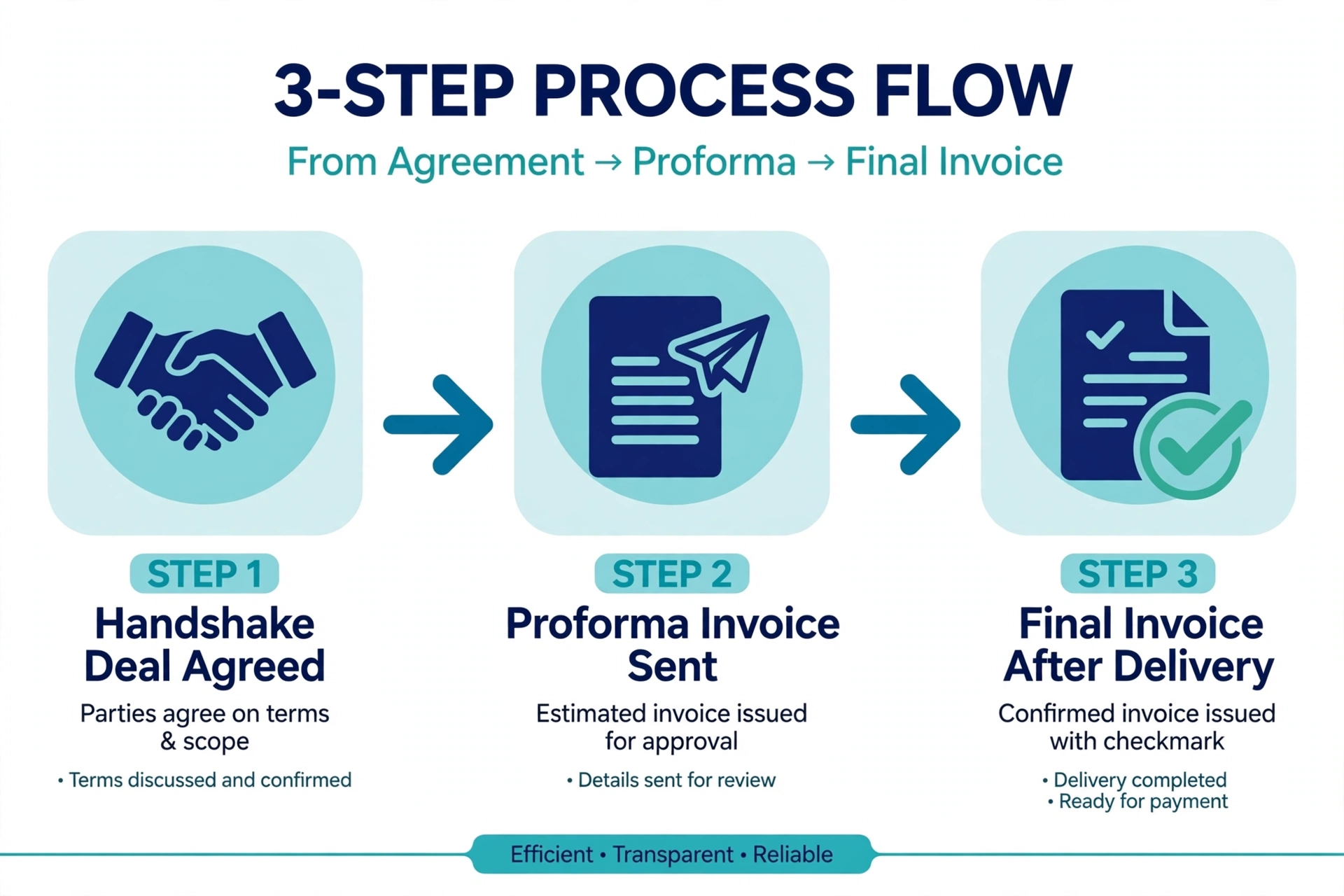
In short: quote first, proforma in the middle, invoice at the end.
How to Convert a Proforma Invoice Into a Final Invoice
When the job is done, turning the proforma into a real invoice takes five small steps:
- Copy the details over — buyer name, items, quantities, prices, totals.
- Change the title from “Proforma Invoice” to “Invoice” (or “Tax Invoice” if VAT/GST applies).
- Give it your next official invoice number — never reuse the proforma reference number.
- Update the date and payment terms — the issue date should be the date you actually send it.
- Send it with a short note — for example: “Attached is the final invoice for the order confirmed in proforma PI-2026-014.”
You can build both documents in seconds with a free invoice generator — no signup, no fees, just fill in the fields and download.
5 Common Mistakes to Avoid
1. Claiming VAT or GST on a proforma invoice.
A proforma is not a tax document. Claiming tax on it can get you in trouble with your tax authority.
2. Mixing proforma numbers into your invoice sequence.
Keep a separate series (like PI-001, PI-002). Your official invoice numbers must run in one clean sequence.
3. Forgetting to send the final invoice.
The buyer paid against the proforma, so you feel done. You are not — your books still need the real invoice.
4. Leaving out an expiry date.
Prices change. Put a line like “This proforma is valid for 30 days” so nobody holds you to old prices forever.
5. Writing vague line items.
“Services: $5,000” invites disputes. Describe each item clearly, the same way you would on a final invoice.
Frequently Asked Questions
Is a proforma invoice legally binding?
Generally, no. It is not a demand for payment and not a tax document. But if both sides sign it or treat it as an agreement, parts of it (like the price) can carry weight in a dispute — so write it carefully.
Can I pay a proforma invoice?
Yes. Many buyers pay in advance based on a proforma, especially in international trade. Just make sure you receive the final invoice after delivery for your own records.
Does a proforma invoice need an invoice number?
It should have a reference number so both sides can track it, but keep it in a separate series from your real invoice numbers. Mixing the two series is one of the most common bookkeeping mistakes.
What is the difference between a proforma invoice and a quote?
A quote is an early price proposal. A proforma invoice is more detailed and formal, usually sent after the buyer has agreed — often for customs clearance or to collect an advance payment.
Do I still need a final invoice if the buyer already paid the proforma?
Yes, always. The proforma cannot go into your official sales records or tax filings. Issue the final invoice after delivery, even when the money is already in your account.
Final Thoughts
A proforma invoice opens the deal. A regular invoice closes it. Use the proforma to agree on price, collect deposits, and clear customs — then always follow up with a proper invoice once the work is done.
If you need to create either document right now, try the free invoice generator at NexBillio — it takes less than a minute, and there is no signup.
3 thoughts on “Proforma Invoice vs Invoice: When to Send Each (With Examples)”