
Did you ever send a document to a client and wonder: is this an invoice or a receipt? You are not alone. Many small business owners and freelancers mix the two up. The mix-up sounds small, but it can delay your payments and confuse your records.
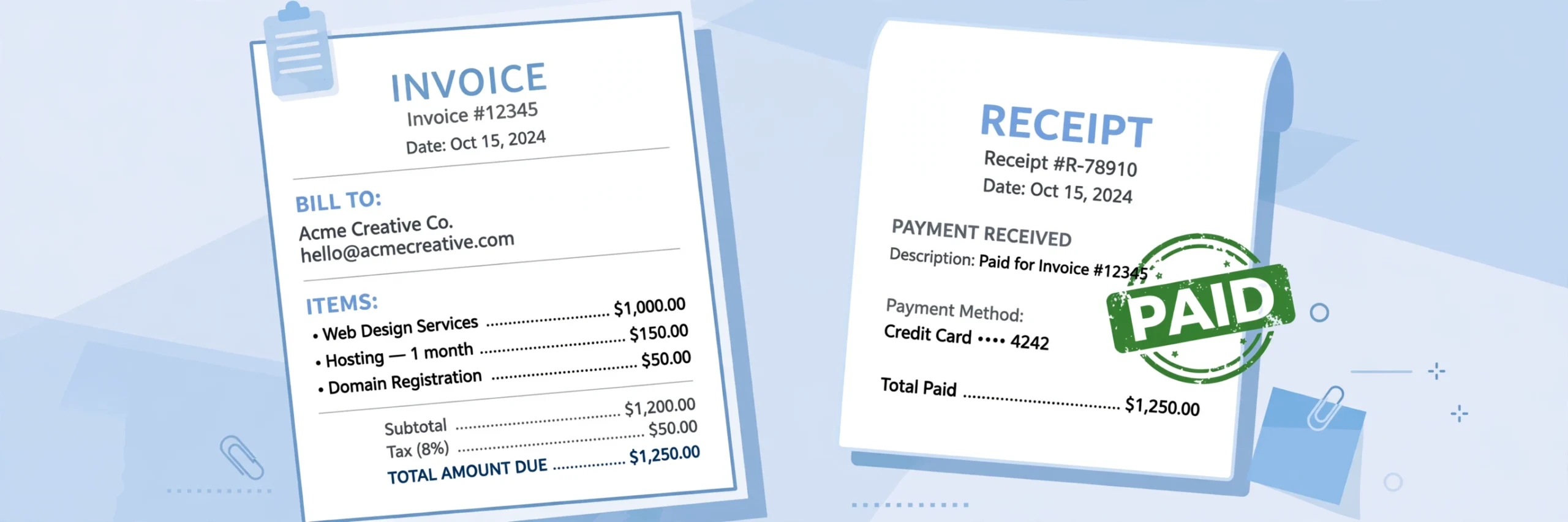
An invoice asks for money. A receipt proves that money was paid. That is the heart of the difference. In this guide, you will learn exactly what each document is, how they differ, and when to send which one.
What Is an Invoice?
An invoice is a bill. You send it to your client before they pay. It lists what you sold or what work you did, how much the client owes, and when the payment is due.
Think of it as a polite request: “Here is what I did for you. Please pay this amount by this date.”
One related document worth knowing is the proforma invoice, which is sent before delivery rather than after. Our guide on proforma invoice vs invoice explains when to send each one, with examples.
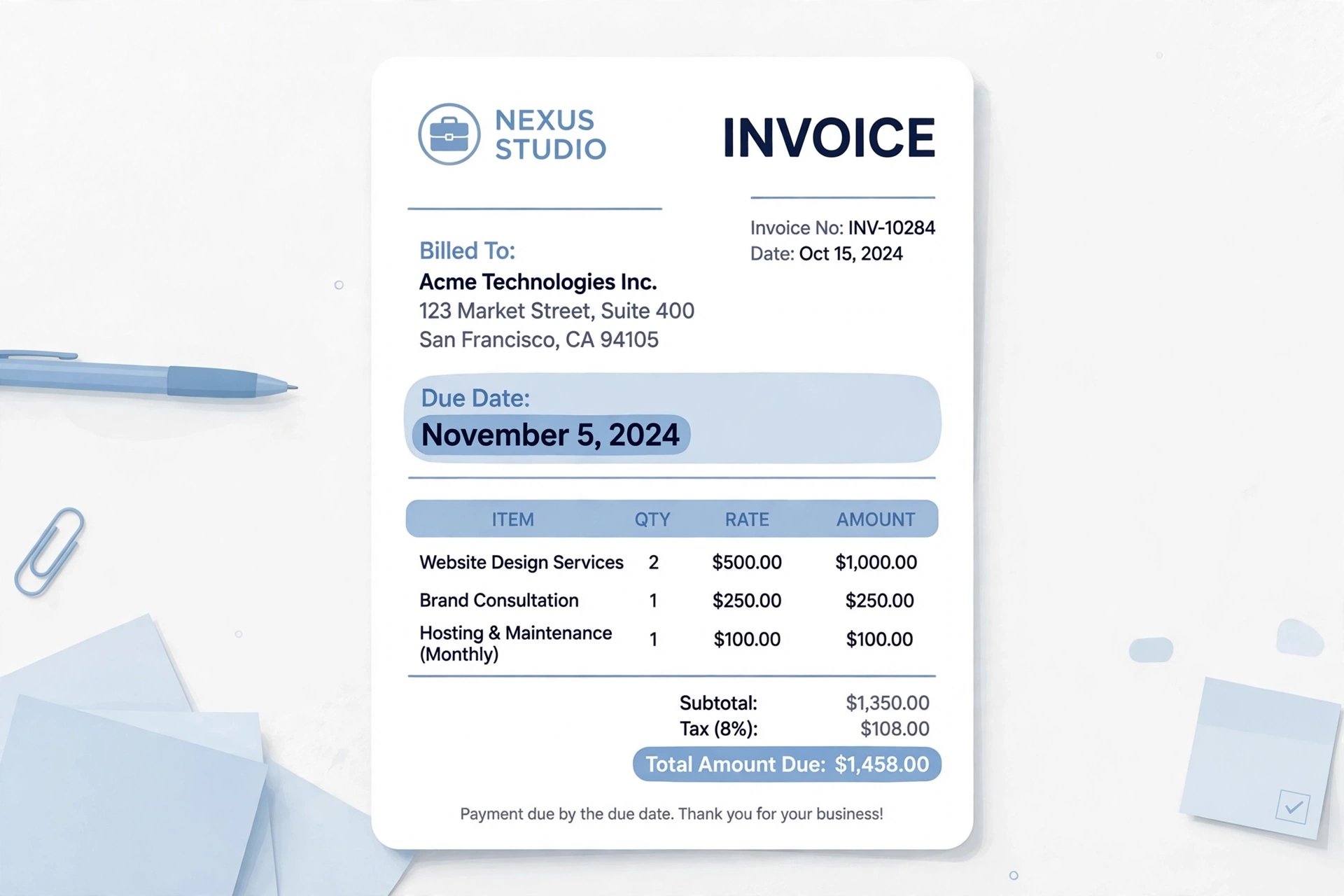
A typical invoice includes:
- Your business name, address, and contact details
- Your client’s name and billing address
- A unique invoice number
- The date it was issued and the due date
- A clear list of products or services, with quantities and prices
- The subtotal, taxes, discounts, and the total amount due
- Your payment details and accepted payment methods
- Any terms or notes, like a late fee policy
Invoices are usually sent as PDFs or through email. With a free invoice generator, you can create one in about a minute, with totals and taxes calculated for you. If you are new to this, start with our guide on how to create an invoice for free.
What Is a Receipt?
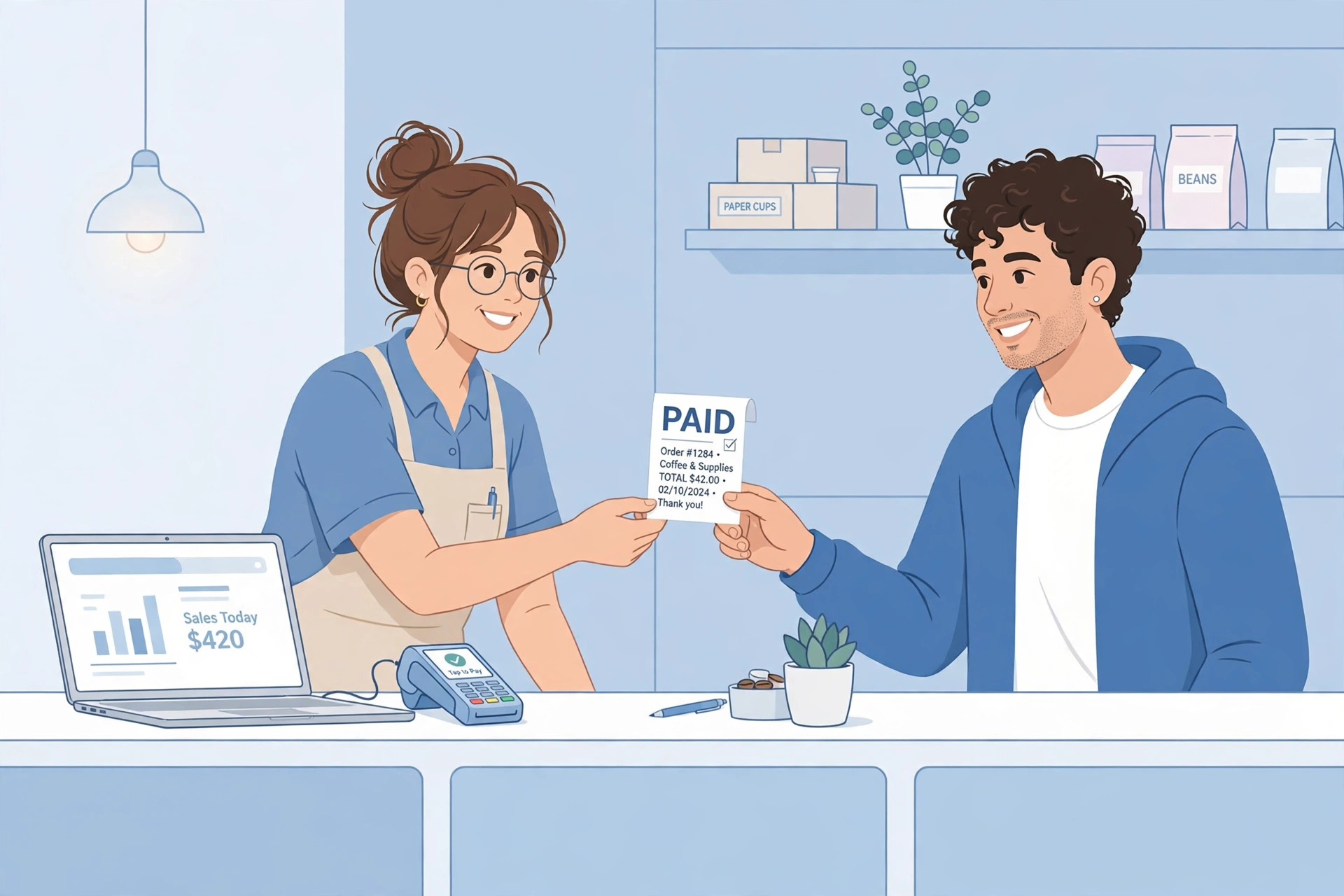
A receipt is proof of payment. You give it to your client after they pay. It confirms that the money was received, how much was paid, and on which date.
Think of it as a confirmation: “Thank you. Your payment is received.”
A typical receipt includes:
- Your business name and contact details
- The date of payment
- A receipt number
- A description of what was paid for
- The amount paid and the payment method used (cash, card, bank transfer)
- The words “Paid” or “Payment Received”
Receipts matter more than people think. Your client may need one for their tax records or expense reports. You may need one as proof if a payment dispute ever comes up.
Invoice vs Receipt: The Comparison Table
Here is the simplest way to see the difference:
| Invoice | Receipt | |
|---|---|---|
| Purpose | Asks for payment | Confirms payment |
| When it is sent | Before payment | After payment |
| Shows an amount due? | Yes — the client still owes this | No — the amount is already paid |
| Due date | Yes, always included | Not needed |
| Payment status | Unpaid / partially paid | Paid in full |
| Who sends it? | The seller or service provider | The seller or service provider |
| Used for taxes? | Used to track income you expect | Used as proof of income received |
One more way to remember it: an invoice creates a debt. A receipt closes it.
Real-Life Examples
Example 1: The invoice
Maria is a freelance graphic designer. She finishes a logo project for a cafe owner and sends an invoice on Monday. It lists the design work, the total of $450, and a due date of 14 days. The cafe owner now knows exactly what to pay and by when. The money has not changed hands yet. That is an invoice.
Example 2: The receipt
The cafe owner pays the $450 on Friday through a bank transfer. Maria then sends a short receipt that says “Payment Received — $450 — Paid in full on Friday.” The cafe owner can now file it with their business expenses. That is a receipt.
Notice how the two documents work as a pair. The invoice starts the payment process. The receipt ends it.
Why Getting This Right Matters
Some people ask: does it really matter which document I send? Yes, it does — for three simple reasons.
First, cash flow. If you send a receipt instead of an invoice, your client sees a document that says “paid.” They may think there is nothing to pay and put it aside. You then wait weeks for money you never properly asked for.
Second, taxes and bookkeeping. Your accountant tracks invoices as money you expect to receive and receipts as money you already received. Mixing them up makes your books wrong, and wrong books cause real trouble at tax time.
Third, disputes. If a client ever claims they never paid, your receipt copy settles it. And if a client claims they were never billed, your invoice copy settles that too. The right document, kept on file, protects you in both directions.
When to Send Which
Here is a simple rule for everyday situations:
Send an invoice when:
- You finished the work and the client has not paid yet
- You want to request a deposit before starting a project
- You bill a client every month (rent, retainers, subscriptions)
- You sell products and payment comes later, like net-30 terms
Send a receipt when:
- The client just paid, in full or in part
- Someone paid in cash and you need written proof
- The client asks for proof of payment for their records
- You refunded someone and want to confirm the refund
What about online stores? Most online stores send both: an order confirmation first, then a receipt once the payment goes through. If payment is due later, they send an invoice instead.
What about partial payments? These are common with big projects. Say a client pays a 50% deposit. Send a receipt for that deposit, and keep the original invoice open for the balance. When the final payment arrives, send a final receipt and mark the invoice as paid in full. This way, every step of the payment has its own paper trail, and neither side has to guess what is still owed.
Still waiting to be paid? Use one of our payment reminder email templates to chase it politely.
Common Mistakes to Avoid
1. Sending a receipt before payment arrives. This is the most common mistake. A receipt says “paid.” If the money is not in your account yet, do not send one. Send an invoice instead.
2. Sending neither document. Some freelancers just send a text message like “send me the money.” That looks unprofessional, and it gives you no paper trail. Always send a proper document.
3. Reusing the same invoice number. Every invoice needs its own unique number. Reused numbers make your records messy and can cause confusion during tax time. Most invoice tools number them for you automatically.
4. Forgetting the due date. An invoice without a due date is just a wish. Clients pay slower when no deadline exists. Always add one — 7, 14, or 30 days are the most common.
5. Leaving out payment details. Your client wants to pay you. Do not make them ask how. Put your bank details, payment link, or accepted methods right on the invoice.
6. Using vague descriptions. “Services rendered” tells the client nothing. Write “Logo design — 3 concepts + 2 revisions” instead. Clear descriptions get paid faster and avoid disputes.
FAQ
Can a receipt replace an invoice?
No. They do different jobs. A receipt cannot ask for payment because it says the payment already happened. An invoice cannot prove payment because it is sent before payment. You need both, used at the right time.
Do I need to send a receipt if the client paid online?
It is still a good idea. Payment apps often send their own confirmation, but a branded receipt from your business looks professional and keeps your records clean. Many tools can create both documents.
Is an invoice a legal document?
An invoice on its own is not a contract, but it is a formal record of a transaction. It can support your case in a payment dispute. For stronger protection, pair your invoices with a written agreement or contract.
What is a paid invoice?
A paid invoice is an invoice that the client has fully paid. Some businesses stamp or mark the invoice as “Paid” and send it back to the client. This works like a simple receipt, though a separate receipt document is cleaner.
Do small businesses really need receipts?
Yes. Even if you are a one-person business, receipts protect you. They prove income for your tax records, settle disputes, and build trust with clients. Keep copies of every receipt you issue.
Conclusion
Invoices and receipts are a simple pair once you see them clearly. The invoice asks for the money before payment. The receipt confirms the money after payment. Use them in that order, keep your numbers unique, and always include the key details.
Good documents do more than keep you organized. They make you look professional, and professional-looking bills get paid faster. If you need to create your next one, try NexBillio’s free invoice generator — no signup, no cost, and your first invoice is ready in about a minute.
Related reading: Still mixing up similar billing documents? See our guide on invoice vs bill for a side-by-side comparison with examples.
3 thoughts on “Invoice vs Receipt: Key Differences, Examples & When to Use Each”