

You get a call from a new client. “Can you give me a number for this job?” You send them a document with the price. The client says yes, you do the work, and then you send another document asking for money.
Most freelancers do this every week. But many get the two documents mixed up. They send the wrong one at the wrong time, and it leads to late payments, arguments about the price, or clients who simply never pay.
The fix starts with knowing the difference between an estimate and an invoice. An estimate comes before the work. An invoice comes after it. That one sentence clears up most of the confusion — but there is more to it. Whether you are a freelancer, a contractor, or a small business owner, the estimate vs invoice distinction will save you from pricing arguments and late payments. This guide walks through all of it in plain English.
What Is an Estimate?
An estimate is a document that tells a client what a job will probably cost before any work starts. Think of it like a guess with numbers. The client asks, “How much will this cost?” and you answer with an estimate. It helps them decide whether to hire you. The word “estimate” matters here. The price is not final. If the job turns out to be bigger than expected, the final price may change. That is normal — the estimate is your best guess, not a locked-in promise.
A good estimate includes:
- Your business name and contact details
- The client’s name
- An estimate number and the date
- A list of the work you plan to do, with a price for each item
- The total estimated cost
- A note that says how long the estimate is valid (for example, “valid for 30 days”)
- A note that the final price may change if the scope of work changes
Example: A painter visits a house and looks at the rooms that need painting. She sends the owner an estimate for $900 — paint, labor, and supplies included. The owner reads it, agrees, and books the job. No money changes hands at this point.
An estimate is very close to a quote — the two words are often used for the same document. If you want to see how a pre-work document differs from a payment request, read our guide on quote vs invoice.

What Is an Invoice?
An invoice is a document that asks a client for payment after the work is done (or after you reach an agreed milestone). If the estimate was your guess, the invoice is the real bill. It tells the client exactly what to pay, when to pay it, and how.
A good invoice includes:
- Your business name and contact details
- The client’s name
- An invoice number and the date
- A list of the work you actually did, with a price for each item
- The total amount due
- The payment due date (for example, “payment due within 14 days”)
- How to pay (bank details, a payment link, and so on)
- Any late-payment terms
Unlike an estimate, an invoice is a request for payment. It creates a payment obligation. When the client receives it, they know the clock is ticking.
Example: The painter finishes the job. It took one extra day because of a wall that needed repair, so the final bill is $1,050 instead of the $900 estimate. She sends an invoice for $1,050 with a due date of 14 days. The owner pays by bank transfer within a week.
Once the client pays, you can send them a receipt as proof of payment. Our guide on invoice vs receipt explains when each one is used.
Estimate vs Invoice: The Key Differences
Here is the estimate vs invoice difference, side by side.
| Estimate | Invoice | |
|---|---|---|
| Purpose | Tells the client what the job will probably cost, so they can decide whether to hire you. | Asks the client to pay for work that is already done. |
| Timing | Sent before the work starts. | Sent after the work is done, or at an agreed milestone. |
| Legal weight | Not legally binding on its own. The price is an educated guess and can change if the work changes. | A formal payment request. If the client accepted your terms, they are expected to pay by the due date. |
| What it must include | Your details, client details, estimate number, date, line items with estimated prices, total, and an expiry date. | Your details, client details, invoice number, date, line items with final prices, total due, payment due date, and how to pay. |
When to Send Each One
Send an estimate when:
- A new client asks for a price before hiring you
- The job is custom, and the price is not fixed in advance
- You need the client to approve the scope of work before you start
- You want a written record of what was agreed, to protect yourself later
Send an invoice when:
- The work is finished and the client owes you money
- You have reached a milestone you both agreed to bill for
- A deposit is due before the work starts (some businesses invoice for deposits)
- A recurring client has a new batch of work completed
The normal order is: estimate first, work second, invoice third. This is how most freelancers, contractors, and small service businesses get paid without confusion.
Some jobs skip one of the two. A fixed-price product sale usually needs no estimate — you send the invoice straight away. A small repeat job for a trusted client can run on a quick email estimate. The rule is simple: use an estimate and an invoice together whenever the price needs approval before you commit your time.
How to Convert an Estimate Into an Invoice
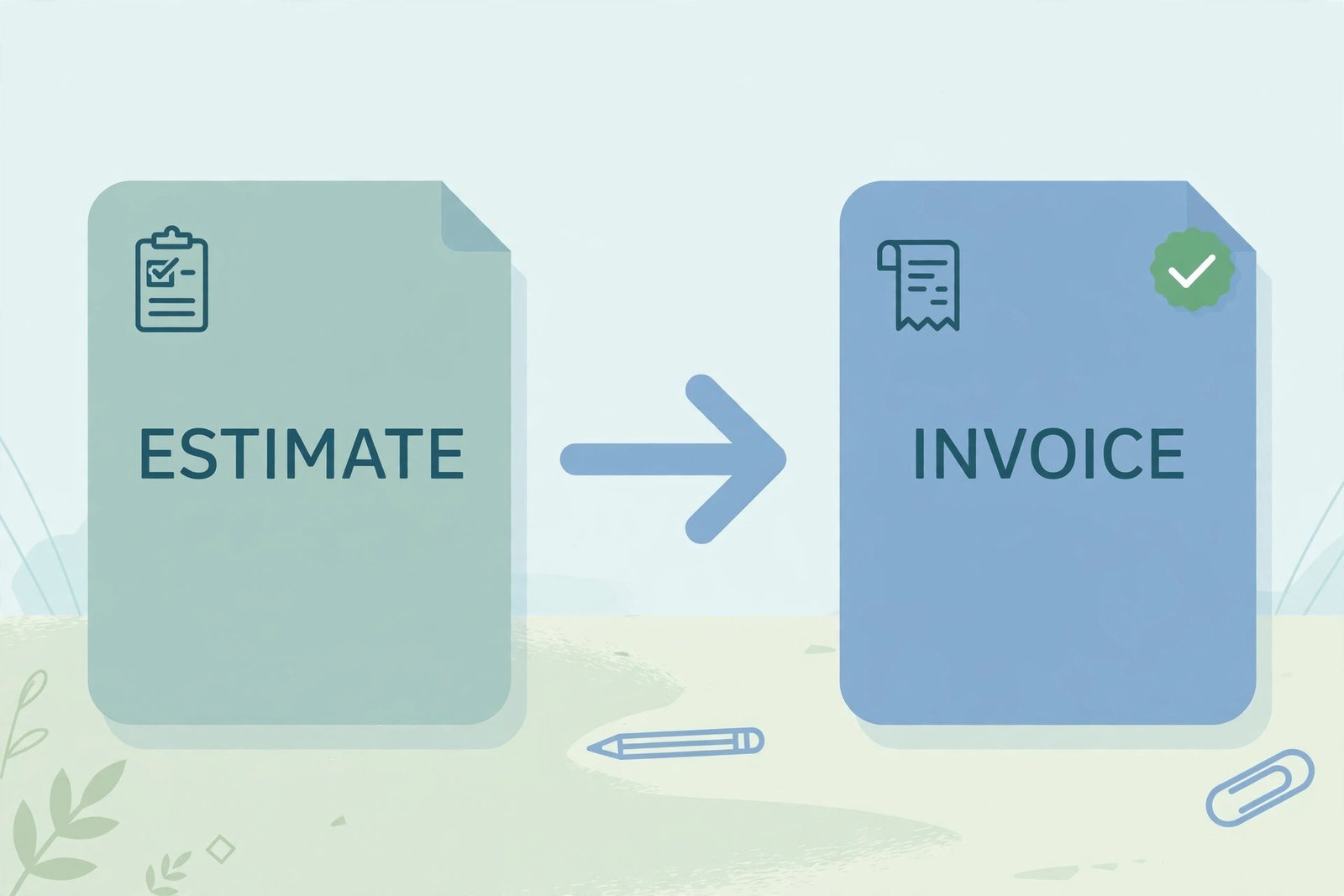
When the client approves your estimate and the work is done, you do not need to start from scratch. Turning the estimate into an invoice takes a few steps:
- Copy the line items. Take the list of work from the estimate and put it on the new invoice. Most of it will be the same.
- Update the prices. If the final cost changed, change the line items and the total. Never leave the old estimate total on the invoice if the numbers are different.
- Change the document details. Replace the estimate number with a new invoice number. Change the date to today’s date. Make sure the word “INVOICE” appears at the top, not “ESTIMATE”.
- Add a payment due date. Estimates have an expiry date; invoices have a due date. Pick one that works for you — 7, 14, or 30 days are common.
- Add how to pay. Include your bank details or a payment link. The client should not have to ask you how to send the money.
- Check it once, then send it. Read the invoice from the client’s point of view. Does the total match the work? Is the due date clear? Is your payment info there?
With a free invoice generator, this takes a couple of minutes. You type in the items, add tax if needed, and download a clean PDF.
Common Mistakes to Avoid
- Sending an invoice before the client approves the estimate. This reads as a demand before an agreement. Get approval first.
- Leaving “ESTIMATE” at the top of an invoice. The document title sets the meaning. An invoice must say “INVOICE”.
- Reusing the estimate number as the invoice number. Every invoice needs its own unique number for your records and taxes.
- Forgetting the due date. An invoice without a due date has no deadline. Always include one.
- Charging the estimate total when the real cost changed. If the job grew, update the numbers. If the change is big, tell the client before you send the invoice.
- Sending estimates with no expiry date. Prices go up over time. An estimate that never expires can be accepted a year later at an old price. Add “valid for 30 days” or similar.
Frequently Asked Questions
Is an estimate the same as a quote?
In most everyday use, yes. Both are documents that give a price before the work starts. Some industries treat a quote as a fixed price and an estimate as a rough guess, but for freelancers and small businesses the two words are usually used the same way.
Is an estimate legally binding?
Usually not. An estimate is a best guess, and the price can change if the work changes. It becomes harder to change the price if the client signed the estimate and it says the price is fixed — so read your own wording before you send it.
Can I send an invoice without an estimate first?
Yes. Many businesses skip the estimate when the price is standard or the client already knows the rates. An estimate is useful for custom or larger jobs; it is not a legal requirement for invoicing.
Should the invoice match the estimate amount?
Ideally, yes — clients expect the bill to match what they approved. If the final cost is different, make sure the difference is fair and explain it. Surprises on an invoice are the fastest way to lose a client.
Can I convert an estimate into an invoice?
Yes, and you should. Once the client approves the estimate and the work is done, turn it into an invoice by updating the numbers, adding a due date, and changing the document title and number. Follow the steps above.
The Bottom Line
An estimate comes before the work. An invoice comes after it. Send the estimate to win the job, send the invoice to get paid, and convert one into the other when the work is done. That is the estimate vs invoice story in a nutshell.
If you are still writing these documents by hand, there is a faster way. Create a free invoice with NexBillio — fill in your items, add tax, and download a professional PDF. No sign-up needed.
3 thoughts on “Estimate vs Invoice: What’s the Difference and When to Convert One to the Other”