
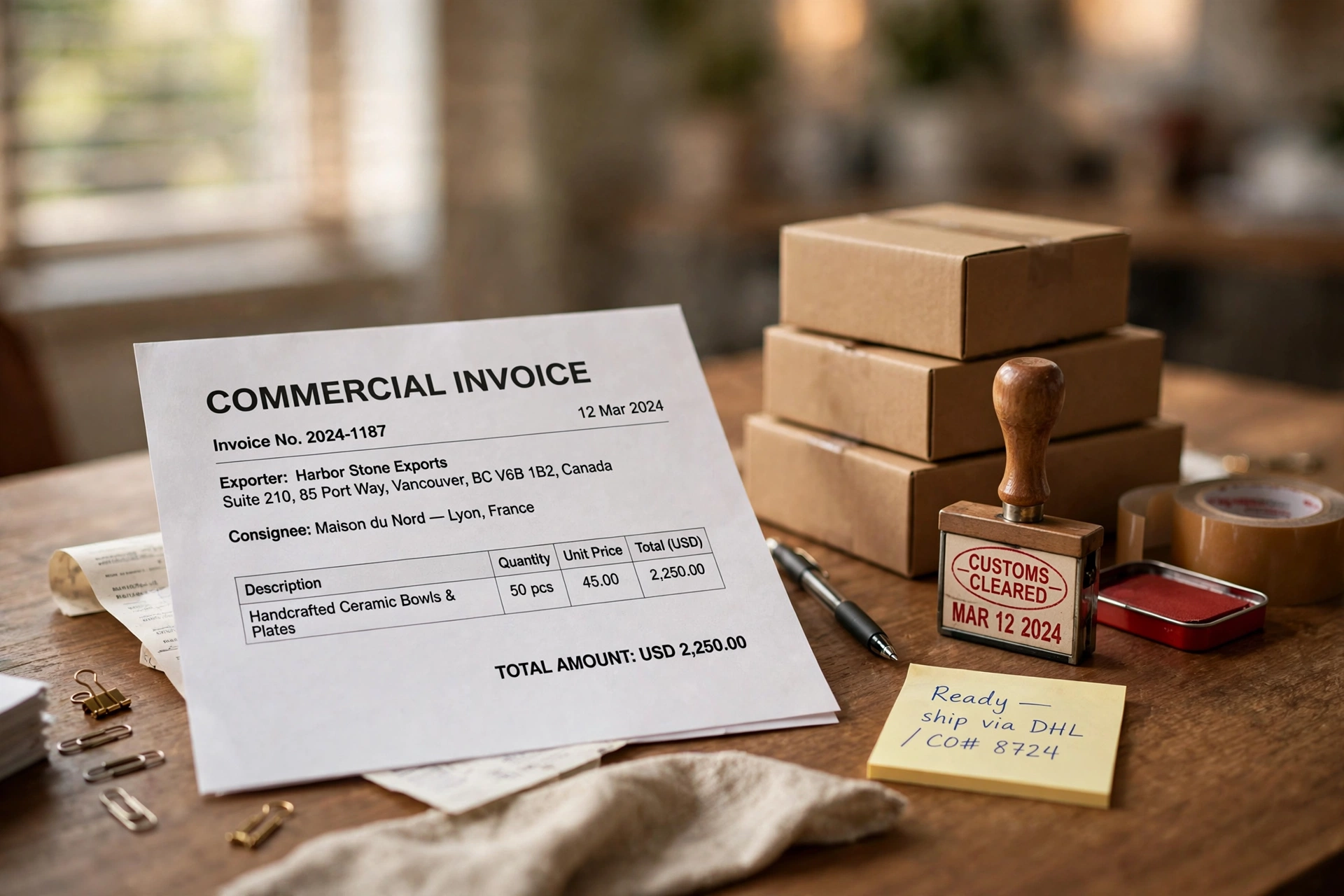
If you sell goods across a border, one document decides whether your shipment moves or sits in a warehouse: the commercial invoice. It is not the same as the invoice you send a local client. Customs officers use it to work out duty and tax, to check what is really in the box, and to decide whether the shipment can enter the country at all.
Get it wrong and the cost is real. A missing field can hold a shipment for days. A wrong value can mean a fine, or duty charged on a number you never agreed. A vague goods description can send the whole box back. This guide explains what a commercial invoice is, when you need one, every field it must carry, and shows a filled example you can copy.
What Is a Commercial Invoice?
A commercial invoice is a customs document. It is the seller’s formal statement of what is being shipped, who sent it, who will receive it, and what it is worth. It travels with the goods, and the customs authority in the destination country reads it before the goods are released.
It also works as a bill. The buyer uses the same document to pay you. But its first job is customs, not payment. That is the difference that matters: a normal invoice is written for the buyer, while a commercial invoice is written for customs first and the buyer second.
Three things make it different from a regular invoice. First, it must describe the goods in enough detail for a customs officer to classify them — not “miscellaneous items” but “cotton linen throw blankets, 100% cotton, 130 × 170 cm”. Second, it states the country where the goods were made, because duty rates depend on origin. Third, it carries the shipment details — the number of packages, the weight, the transport method — that a local invoice never needs.
When Do You Need One?
You need a commercial invoice whenever goods cross an international border and customs has to clear them. That covers most export sales, and a few cases people forget.
You need one when you sell products to a customer in another country, even if the order is small. A single parcel shipped abroad usually still needs one, attached to the outside of the box or filed with the courier. You need one when you send goods to your own warehouse, shop, or trade-show stand in another country — no sale has taken place, but customs still wants to know what is crossing the border and what it is worth. You need one for samples and gifts too: the value is still declared, even when the price is zero, because customs charges duty on value, not on whether money changed hands.
You do not need a commercial invoice for a purely local sale, or for a service with nothing physical crossing a border. If you are a designer in London billing a client in Berlin for a logo, that is a normal invoice. If you are the same designer shipping 200 printed tote bags to Berlin, that shipment needs a commercial invoice. The test is simple: if a physical parcel crosses a border, the parcel needs a commercial invoice. For the official rules on moving goods out of the UK, see the official UK export guidance.
One more case: some countries ask for a commercial invoice even for goods that arrive by email or download — no, that is a myth. Digital products do not need one. But anything you can hold in your hand, and that travels, does.
What to Include on a Commercial Invoice
Customs officers check the same fields on every shipment. Leave one out and the shipment waits while someone emails you for it. Here are the fields that belong on every commercial invoice.
Seller (exporter) details. Your full business name, address, phone, and email. This is who is responsible for the shipment.
Buyer (consignee) details. The full name and delivery address of the person or business receiving the goods. A PO box is not enough — customs wants a street address.
Invoice number and date. A unique number for this shipment, plus the date you issued it. Use a clear invoice numbering system so no two shipments share a number.
Description of goods. The most important field. Write what each item is, what it is made of, and how many there are. “Cotton linen throw blankets, 100% cotton, 130 × 170 cm, 200 pcs” clears customs. “Home goods” does not.
Quantity and unit price. How many of each item, and the price of one. Customs multiplies these to check your total, so they must agree.
Total value and currency. The full value of the shipment, in one currency — usually USD, EUR, or GBP. State the currency clearly: “USD 4,850.00” leaves no doubt.
Country of origin. Where the goods were made, not where they were shipped from. A blanket made in China and shipped from a warehouse in the Netherlands still has China as its country of origin.
Weight and number of packages. The total gross weight and how many boxes or pallets make up the shipment. Couriers and customs both use this.
Incoterms. The three-letter trade term that says who pays for shipping and insurance, and where responsibility passes from seller to buyer — for example “FOB Shenzhen” or “DDP Berlin”. If you are not sure which term your sale uses, check the contract before you write it on the invoice.
Payment terms. When and how the buyer pays — for example “Net 30” or “Payment in advance”.
Reason for export. One line: sale, sample, gift, return, or repair. This stops customs guessing why the goods are travelling.
Signature. A signed declaration that the details are true. Many customs offices still ask for a wet signature or a typed name with a declaration line.
Worked Example: A Real Commercial Invoice
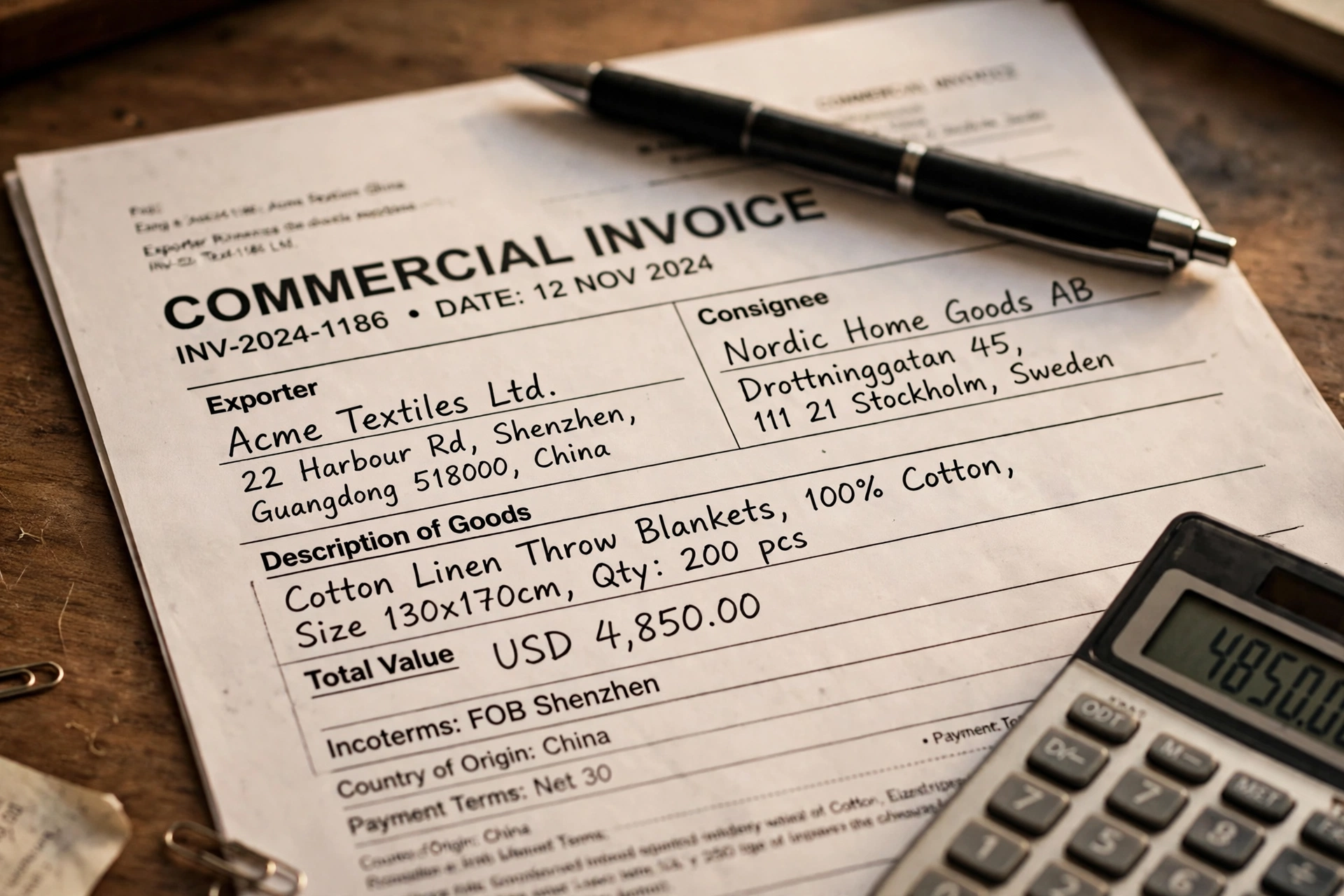
Acme Textiles Ltd., a small textile exporter in Shenzhen, China, ships 200 cotton linen throw blankets to Nordic Home Goods AB in Stockholm, Sweden. The blankets cost USD 24.25 each. Here is what the commercial invoice looks like.
Exporter: Acme Textiles Ltd., 22 Harbour Rd, Shenzhen, Guangdong 518000, China. Consignee: Nordic Home Goods AB, Drottninggatan 45, 111 21 Stockholm, Sweden. Invoice number INV-2024-1186, dated 12 November 2024. Description of goods: Cotton Linen Throw Blankets, 100% Cotton, Size 130 × 170 cm, Qty: 200 pcs. Total value: USD 4,850.00. Incoterms: FOB Shenzhen. Country of origin: China. Payment terms: Net 30. Reason for export: Sale.
Check the maths the way a customs officer would: 200 blankets × USD 24.25 = USD 4,850.00. The unit price times the quantity equals the total value exactly. If those three numbers do not agree, the invoice goes back for correction before the goods move.
Notice what is not on the invoice: no marketing slogans, no discount codes, no extra pages. A commercial invoice is a working document. Everything on it answers a question customs will ask, and nothing on it is decoration.
Commercial Invoice vs Proforma Invoice vs Packing List
These three documents travel together so often that people mix them up. They are not the same, and each one has a different job.
| Document | What it does | When it is used | Is it a bill? |
|---|---|---|---|
| Commercial invoice | Declares goods, value and origin to customs | With every cross-border shipment | Yes, the buyer pays against it. |
| Proforma invoice | A quote in invoice form, before the sale is final | Before the buyer commits, or to get an import permit | No, it is not a demand for payment. |
| Packing list | Lists what is inside each box, by weight and count | Inside or attached to the shipment | No, it proves the contents, not the price. |
A proforma invoice comes first: it tells the buyer what the deal would look like. A commercial invoice comes with the goods: it tells customs what the deal actually is. A packing list sits beside both: it tells the warehouse what is in each box. If you send a proforma invoice and then ship the goods, the buyer still needs a commercial invoice for customs — the proforma alone will not clear the shipment.
Common Commercial Invoice Mistakes (and How to Fix Them)
Mistake 1: Vague goods descriptions. Writing “gifts” or “miscellaneous” on the invoice. Customs cannot classify vague goods, so the shipment is held. Fix: name the item, the material, and the size. “Ceramic bowls, handcrafted, 50 pcs” clears; “homeware” does not.
Mistake 2: Understating the value. Writing a lower value to cut the duty. This is the most expensive mistake on this list. If customs finds the real price — from your website, your emails, or the buyer’s own records — the shipment can be seized and the seller fined. Fix: declare the true transaction value, every time.
Mistake 3: Wrong country of origin. Writing the country the goods shipped from instead of where they were made. Duty rates are set by origin, so this error changes the tax. Fix: origin is where the goods were manufactured, not where the warehouse is.
Mistake 4: Numbers that do not add up. Unit price times quantity does not equal the total. This is a small slip that causes a big delay, because customs will not guess which number is right. Fix: check the maths before you send the invoice — quantity × unit price = total, every line, every time.
Mistake 5: Missing Incoterms. Leaving the delivery terms blank, so nobody knows who pays for shipping and insurance if something goes wrong. Fix: agree the Incoterm with the buyer before you ship, and write it on the invoice.
Mistake 6: Reusing an old invoice number. Two shipments with the same number look like one shipment sent twice, and the second one gets stopped. Fix: use a numbering system that never repeats — year plus a running number works for most small exporters.

How to Make a Commercial Invoice in Minutes
You do not need special export software to make your first commercial invoice. A clear invoice format with the fields above is enough for most small shipments.
- Start with your business details and the buyer’s full address.
- Give the shipment a unique invoice number and today’s date.
- List every item with a plain, specific description, the quantity, and the unit price.
- Add up the lines and write the total value with the currency.
- Add the country of origin, the weight, the number of packages, and the Incoterm.
- Check the maths, sign the declaration, and attach a copy to the outside of the parcel as well as filing one with the courier.
If you want to skip the layout work, use a free invoice generator to build the document, then add the export fields — origin, Incoterms, weight, and packages — before you print it. Keep a copy of every commercial invoice you issue: customs can ask about a shipment months after it arrived, and your copy is your proof.
FAQ
Q: Do I need a commercial invoice for a small parcel?
A: Usually, yes. Most countries want one for any goods crossing the border, even a single small parcel. The courier will often ask for it before they accept the shipment. A few low-value thresholds exist, but they vary by country, so do not assume your parcel is exempt.
Q: Is a commercial invoice the same as a normal invoice?
A: No. A normal invoice asks the buyer to pay. A commercial invoice does that too, but its main job is to tell customs what is in the shipment, where it was made, and what it is worth. A local sale needs only a normal invoice; an export needs a commercial invoice.
Q: Can I use a proforma invoice instead?
A: No. A proforma invoice is a quote, not a customs declaration. Customs will not clear a shipment on a proforma alone — the commercial invoice is the document they accept as the record of the sale.
Q: What happens if the value on the invoice is wrong?
A: If the value is too high, the buyer pays too much duty. If it is too low, customs may hold the goods, re-value them, fine the seller, or in serious cases seize the shipment. Always declare the true transaction value.
Q: Who fills in the commercial invoice — the seller or the courier?
A: The seller does. The courier may provide the form or file it for you, but the details — the goods, the value, the origin — are yours to state, and you are responsible for them being true.
Make Your Next Export Simple
A commercial invoice is not hard once you know what customs is looking for: who sent it, who receives it, what is inside, where it was made, and what it is worth. Write those fields clearly, check your maths, and most shipments clear without a second look.
When the invoice itself is ready, the rest is paperwork you can finish in minutes. Use our free invoice generator to build the document — no sign-up, no watermark — then add the export fields above and send your goods on their way.
1 thought on “Commercial Invoice Explained: What It Is, What to Include & Example for Exporters”