

Sarah runs a small design studio in Manchester. Her first VAT invoice came straight back from the client’s accounts team: no VAT number, the wrong tax point date, and VAT on one line that did not match the rate. Payment was delayed three weeks. It was a crash course in VAT invoice requirements UK businesses have to get right.
A VAT invoice with a missing detail is worse: your customer may not be able to reclaim the VAT, and your payment stalls.
This guide covers the full HMRC checklist, the simpler rules for small sales, the three VAT rates with a worked example, and the common mistakes with a fix for each one.
What Is a VAT Invoice?
A VAT invoice is a normal invoice with extra details: the same basics — who you are, who the customer is, what you sold, and how much they owe — plus the VAT breakdown HMRC requires: your VAT registration number, the VAT rate on each line, and the VAT amount.
That breakdown is the whole point of the document. Your customer needs it to reclaim the VAT they paid you. Without a valid VAT invoice, a VAT-registered customer usually cannot claim that VAT back — it is also their proof for their own VAT return.
You may only issue one if your business is registered for VAT. If you are not VAT-registered, you must not charge VAT, show a VAT number, or call your document a VAT invoice. Send a normal invoice instead. If you are unsure what belongs on a normal invoice, start with our guide to what to include on an invoice, then add the VAT details here.
Who Must Issue a VAT Invoice?
You must issue a VAT invoice if your business is VAT-registered and you make a standard-rated or reduced-rated supply to another VAT-registered business — in plain words, if you charge VAT and your customer is also VAT-registered. That is the first of the VAT invoice requirements UK businesses need to know.
You do not have to issue one to every customer. If you sell to a member of the public who is not VAT-registered, a normal invoice or a simple receipt is usually enough. But if a VAT-registered customer asks for one, you must give them one.
Two rules are worth knowing. First, you must register for VAT once your taxable turnover passes £90,000 in a rolling 12-month period, or you can register voluntarily before that. Second, never issue a VAT invoice for an exempt supply, because there is no VAT to show on it. Check HMRC’s VAT notices for your sector if you are unsure of the rate.
The Full VAT Invoice Checklist: Every Field HMRC Requires
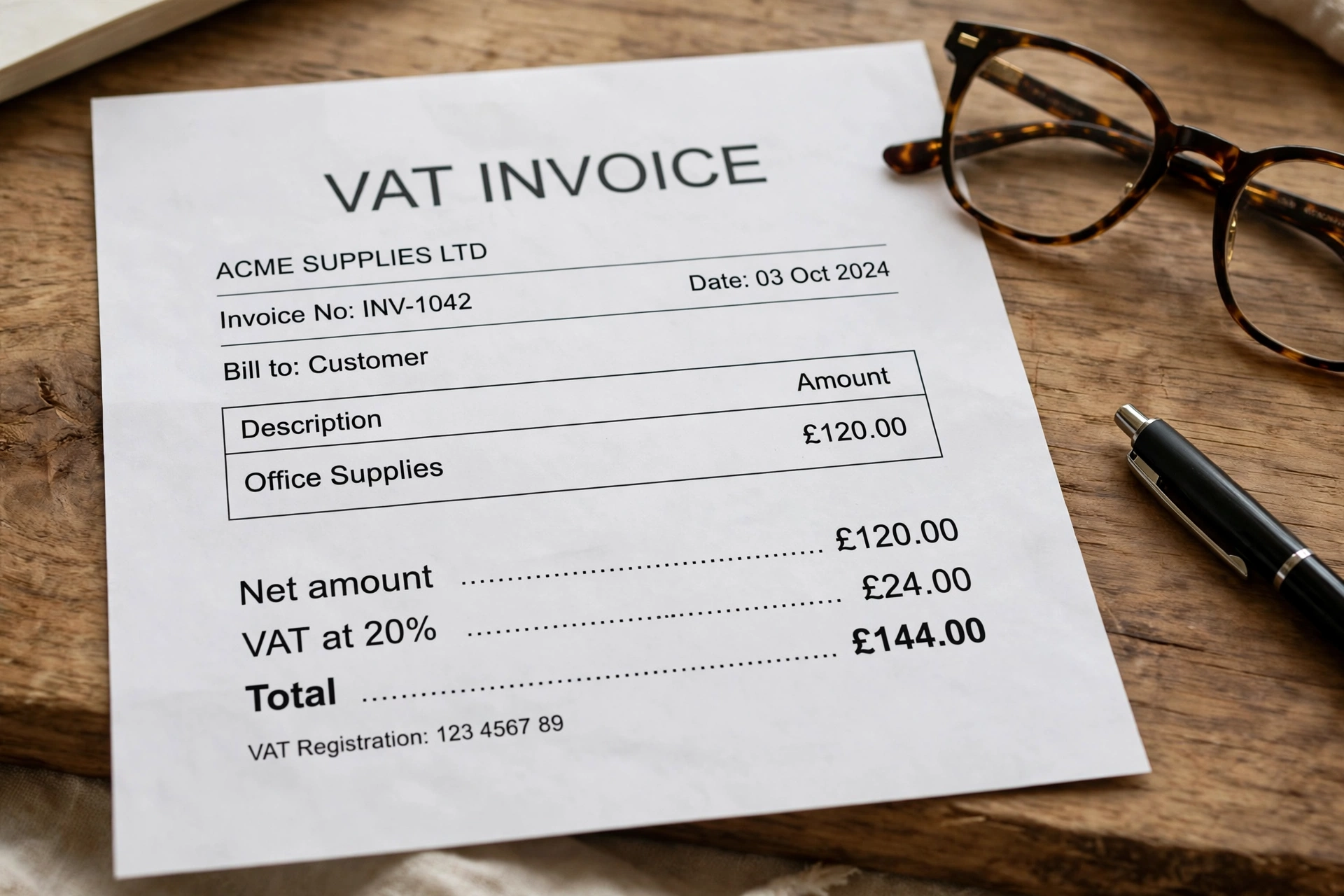
A full VAT invoice is the standard type for any sale, and the type your business customers expect. HMRC requires every field below — miss one, and the invoice may not count as valid. Each item below is part of the VAT invoice requirements UK businesses must meet.
- A unique, sequential invoice number. No two invoices should share a number, and the numbers should run in order. For help setting one up, read our guide to invoice numbering systems.
- The date of issue. The date you send the invoice, written out in full, for example “6 November 2026”.
- The tax point — the date of supply. When the goods were delivered or the service was completed. It is often the same as the date of issue, but if you finished the work in October and invoiced in November, the tax point is the October date.
- Your business name and address. Your trading name and business address, as registered with HMRC.
- Your VAT registration number. Your VAT number, usually shown as “VAT No. GB 123 4567 89” — the field customers check first.
- Your customer’s name and address. The full name of the customer business and their billing address. This is what sets a full VAT invoice apart from a simplified one.
- A description of the goods or services. Say what you sold, clearly enough that a stranger could understand it — “Website redesign, delivered 30 October 2026”, not “Services”. Include the quantity where it applies.
- The price per item, excluding VAT. The net price of each line.
- The VAT rate charged on each line. Show the rate next to each line, for example “20%” or “5%”. If different lines carry different rates, show each one separately — never use one blended rate.
- The total amount excluding VAT. All net line prices added into one subtotal.
- The total amount of VAT. The VAT amount, shown by rate if more than one applies. For example: “VAT at 20%: £200.00; VAT at 5%: £10.00; Total VAT: £210.00.”
- The total amount payable including VAT. The total excluding VAT plus the total VAT — make it the easiest number on the page to find.
- Amounts in another currency, if that applies. If you invoice in euros or dollars, show the VAT in sterling too. Most UK businesses invoice in pounds and can skip this.
That is the full list.
Simplified VAT Invoices: For Supplies of £250 or Less
For a supply of £250 or less including VAT, you can issue a simplified VAT invoice — the type most often used for small retail sales and small expenses.
It must still show a unique invoice number, your name, address and VAT number, the tax point, a description of the goods or services, the total including VAT, and the VAT rate on each item.
You can leave off the customer’s name and address, the price excluding VAT, and the separate VAT total.
There are two limits. First, the £250 limit includes VAT, so a £220 job plus £44 VAT (£264 in total) is already over the limit and needs a full invoice. Second, you cannot use one if the supply includes any exempt items. The same works in reverse: a simplified VAT invoice is usually enough for you to reclaim VAT on a small business purchase.
Modified VAT Invoices: For Retail Sales Over £250
A modified VAT invoice is for a retail sale over £250 including VAT, when the customer asks for a VAT invoice and agrees to this format.
A modified invoice shows the same information as a full VAT invoice, except the prices are shown including VAT. The totals at the bottom still show the amount excluding VAT and the VAT amount, so the customer can see the split.
The key condition is the customer’s agreement — you cannot switch a business customer to a modified invoice without asking. Most prefer the full invoice, because their accounts team works from net prices. Modified invoices suit retail, where customers expect to see the price they actually paid.
The Three VAT Rates — With a Worked Example
The UK has three VAT rates, decided by what you sell, not who buys it. The rates are a core part of the VAT invoice requirements UK businesses follow. Getting the rate wrong is expensive: it changes the VAT your customer reclaims and the VAT you owe HMRC.
Standard rate — 20%. The rate for most goods and services: clothing, electronics, professional services, and restaurant meals. If you are unsure, this is the most likely rate — but check before you assume.
Reduced rate — 5%. A narrower list: domestic fuel and power, children’s car seats, and some energy-saving materials.
Zero rate — 0%. Some supplies are taxed at 0%: most food, books and newspapers, children’s clothing, and exports of goods. Zero-rated is not the same as exempt: with a zero-rated sale you charge no VAT but can still reclaim the VAT on your own costs, while with an exempt sale you cannot.
Worked example: a freelance consultant charges £1,000 at the standard rate:
- Net price (excluding VAT): £1,000.00
- VAT at 20%: £1,000 × 20% = £200.00
- Total payable (including VAT): £1,000 + £200 = £1,200.00
At the reduced rate the same job would be £1,050; at the zero rate, £1,000 flat. The maths is simple — the rate is everything.
Full vs Simplified vs Modified: A Comparison Table
| Full | Simplified | Modified | |
|---|---|---|---|
| Use it for | Any sale | Up to £250 incl. VAT | Retail over £250 |
| Customer details | Required | Not required | Required |
| Supplier VAT number | Required | Required | Required |
| Invoice number | Required | Required | Required |
| Tax point | Required | Required | Required |
| Net line prices | Required | Not required | Shown incl. VAT |
| VAT rate per line | Required | Required | Required |
| Total excl. VAT | Required | Not required | Required (at bottom) |
| VAT total | Required | Not required | Required |
| Total incl. VAT | Required | Required | Required |
When in doubt, issue a full VAT invoice — it works for any amount.
5 Common VAT Invoice Mistakes (and How to Fix Them)
Mistake 1: No VAT number on the invoice. Without your VAT number, your customer cannot reclaim the VAT. Fix: add your VAT number to your invoice template once, so it appears on every invoice.
Mistake 2: The wrong VAT rate. Charging 20% on a reduced-rate supply overcharges your customer; 5% on a standard-rated supply undercharges HMRC. Fix: check the rate before you invoice, and split the lines if you sell a mix of rates.
Mistake 3: No sequential invoice number, or a reused number. HMRC expects numbers to run in order, and your customer needs a unique number to match the payment. Fix: start a simple numbering system today and never reuse a number. If you sent two invoices with the same number, reissue one with a new number and a short note.
Mistake 4: The wrong tax point date. The tax point decides which VAT period the sale belongs to, so the wrong date can put it in the wrong VAT return. Fix: always ask, “When did I deliver this?” and use that date. If the work finished in one month and you invoiced in the next, show both dates.
Mistake 5: Issuing a VAT invoice when you are not VAT-registered. This happens when a business charges VAT before its registration is complete, or copies a VAT invoice template by mistake. Fix: do not add VAT until your registration is confirmed and you have your VAT number — until then, send a normal invoice with no VAT line.
Record-Keeping: Keep VAT Records for 6 Years
HMRC requires you to keep your VAT records for at least 6 years — every VAT invoice you issue and receive, your VAT account, and the records behind each VAT return. Keeping them is part of the VAT invoice requirements UK businesses must follow.
Keep digital copies of every invoice, filed by tax year, and back them up somewhere other than your laptop. Your software should keep the full invoice — not just the total — for the whole period.
If you deregister, the rule does not end: keep the records for 6 years after deregistration, and longer if HMRC opens an enquiry.
Frequently Asked Questions
Do I have to issue a VAT invoice to every customer?
No. You must issue one to a VAT-registered customer for a standard-rated or reduced-rated supply. For a customer who is not VAT-registered, a normal invoice or receipt is usually enough — but if a VAT-registered customer asks for one, you must give them one.
Can I use a simplified VAT invoice for a £300 sale?
No. The simplified invoice is only for supplies of £250 or less including VAT. A £300 sale needs a full VAT invoice, or a modified one if it is a retail sale and the customer agrees. The £250 limit includes the VAT, so check the total with VAT.
What is the tax point, and why does it matter?
The tax point is the date the goods were delivered or the service was completed. It decides which VAT period the sale belongs to, and therefore which VAT return it goes on. If it matches the invoice date, show one date; if the work finished earlier, show both dates.
I am not VAT-registered. Can I still send an invoice with VAT on it?
No. Only VAT-registered businesses may charge VAT and issue VAT invoices. If you are not registered, send a normal invoice with no VAT line and no VAT number. If your turnover is near the £90,000 threshold, start registering early.
How long must I keep VAT invoices?
At least 6 years — every VAT invoice you issue and receive, plus your VAT account and the records behind each return, even after you deregister, and longer if HMRC has an open enquiry.
The Bottom Line
VAT invoice requirements UK businesses must follow come down to one idea: show HMRC and your customer everything they need, in one document, with maths that adds up. A full VAT invoice with your VAT number, a sequential number, the right tax point, the rate on every line, and a clear total will pass every time.
To skip the formatting, create one with NexBillio’s free invoice generator — no sign-up, no watermark, and the PDF is ready to send in seconds. Fill in the fields above, check the VAT rate once, and send it.
1 thought on “UK VAT Invoice Requirements: The Full HMRC Checklist”