
You finished the work. Now you need to get paid. The invoice you send is the document that makes that happen — but only if it has everything on it. Many invoices get paid late for a simple reason: something is missing. There is no invoice number, so the customer cannot find it in their system. There is no due date, so nobody knows when to pay. There is no payment method, so the customer has to email you and ask how to pay. Each missing piece adds days, sometimes weeks, to your wait. This guide gives you the full answer to what to include on an invoice. You will get a checklist of every part, a filled example you can copy, and the common mistakes that delay payment — with a fix for each one. By the end, you will be able to send an invoice that a customer can pay without asking you a single question, because you will know exactly what to include on an invoice.
The Short Answer: The 10 Parts Every Invoice Needs
If you only remember one list from this guide, make it this one. Every professional invoice needs these ten parts:
- The word “Invoice” at the top, so it is clear what the document is.
- Your business name, address, and contact details.
- Your customer’s name and address.
- A unique invoice number.
- The invoice date and the due date.
- A clear description of what you sold or did.
- Quantities, rates, and line totals.
- Tax, if it applies.
- The total amount due.
- How and when to pay.
Leave one of these out of what to include on an invoice and you invite a question, a delay, or a dispute. Put them all in and your invoice does most of the chasing for you.
1. Your Business Details
Start with who you are. Put your business name at the top of the invoice, with your address, email address, and phone number underneath. If you have a logo, put it at the top too — it makes the invoice look professional and helps the customer recognise it at a glance.
2. Your Customer’s Details
Next, say who the invoice is for. Write the customer’s full name — or their business name, if you worked for a company — plus their billing address. If you know the name of the person who approves payments, add that too, for example “Accounts Department, attention: Sarah Jones”.
3. A Unique Invoice Number
Every invoice needs its own number, and no two invoices should ever share one. The number is how both you and your customer track the payment. When a customer pays, they usually quote the invoice number, so you can match the money to the job. Keep your numbering simple and in order. Many small businesses start at INV-001 and count up: INV-002, INV-003, and so on. Others add the year, for example INV-2026-001. What matters is that the system is clear, that you never reuse a number, and that you never skip one without a note. If you want a deeper guide to formats that grow with your business, read our guide to invoice numbering systems.
4. The Invoice Date and the Due Date
Two dates matter on every invoice, and they do different jobs. The invoice date is the date you send the invoice. It starts the payment clock. The due date is the date by which you expect to be paid. Always write both dates in full, for example “Invoice date: 5 November 2026” and “Payment due: 5 December 2026”. Short dates like 05/11 can mean May 11 in one country and November 5 in another, so spelling the month out avoids confusion.
5. A Clear Description of the Work
This is the part customers read most carefully, and it is where vague invoices fail. “Services rendered” tells the customer nothing. They cannot check it, they cannot approve it, and they may send it back with questions. Instead, describe what you actually did, in plain words. Write “Website homepage redesign — 3 pages, copy and layout, delivered 28 October 2026” rather than “Design work”. Write “Garden maintenance — 4 visits in October, lawn mowing and hedge trimming” rather than “Gardening”. If you delivered a product, name it, with the size, colour, or model if that matters.
6. Quantities, Rates, and Line Items
Under the description, list each item on its own line. For each line, show four things: what it is, how many there are, the price per unit, and the line total. Here is a simple example:
Website homepage redesign — 1 × $400 = $400
Extra landing page — 1 × $150 = $150
Stock photos licence — 3 × $20 = $60
Then add the lines up into a subtotal. In this example, the subtotal is $610. If you charge by the hour, show the hours and the hourly rate on each line: “Consulting — 6 hours × $75 = $450”. If you charge a flat fee, say so: “Logo design — flat fee = $500”. Either way, the customer should be able to follow the total from the lines to the final amount without guessing.
7. Tax
If tax applies to your work, show it as its own line, after the subtotal and before the total. Write the tax name, the rate, and the amount, for example “Sales tax (8%) — $48.80” or “VAT (20%) — $122.00”.
8. The Total Amount Due
After the subtotal and the tax, write the total in big, clear numbers: “Total due: $658.80”. If the customer already paid a deposit, show that too, and then the balance left to pay:
Subtotal: $610.00
Tax (8%): $48.80
Total: $658.80
Deposit paid 20 October: −$200.00
Balance due: $458.80
9. How to Pay
This is the part that turns an approved invoice into money in your account. Tell the customer exactly how to pay, and make it as easy as possible. Include your bank details for a bank transfer, a payment link if you take card payments, or your payment app handle if that is how you work. If you take more than one method, list them all, and say which one you prefer. Also write your payment terms again here, in one sentence: “Please pay within 30 days of the invoice date.” If you charge a late fee, say so here too, in plain words, for example: “Invoices unpaid after the due date may carry a late fee of 1.5% per month.” Customers accept a late fee far more easily when it was on the invoice from the start than when it appears as a surprise later.
10. Extra Details That Prevent Questions
The ten parts above are the core of what to include on an invoice. A few extra lines, added only when they fit your work, can prevent the most common follow-up questions:
Purchase order number: if the customer gave you one, put it on the invoice. Many companies cannot pay without it. Project or job reference: useful when you do repeat work for the same customer. Delivery or completion date: helpful when the invoice date is later than the work date. A short thank-you note: one line, such as “Thank you for your business”, costs nothing and keeps the tone friendly. Your terms and conditions: keep these short on the invoice itself, and put the full version on your website or in your contract, not in tiny print at the bottom of every invoice.
A Filled Example You Can Copy
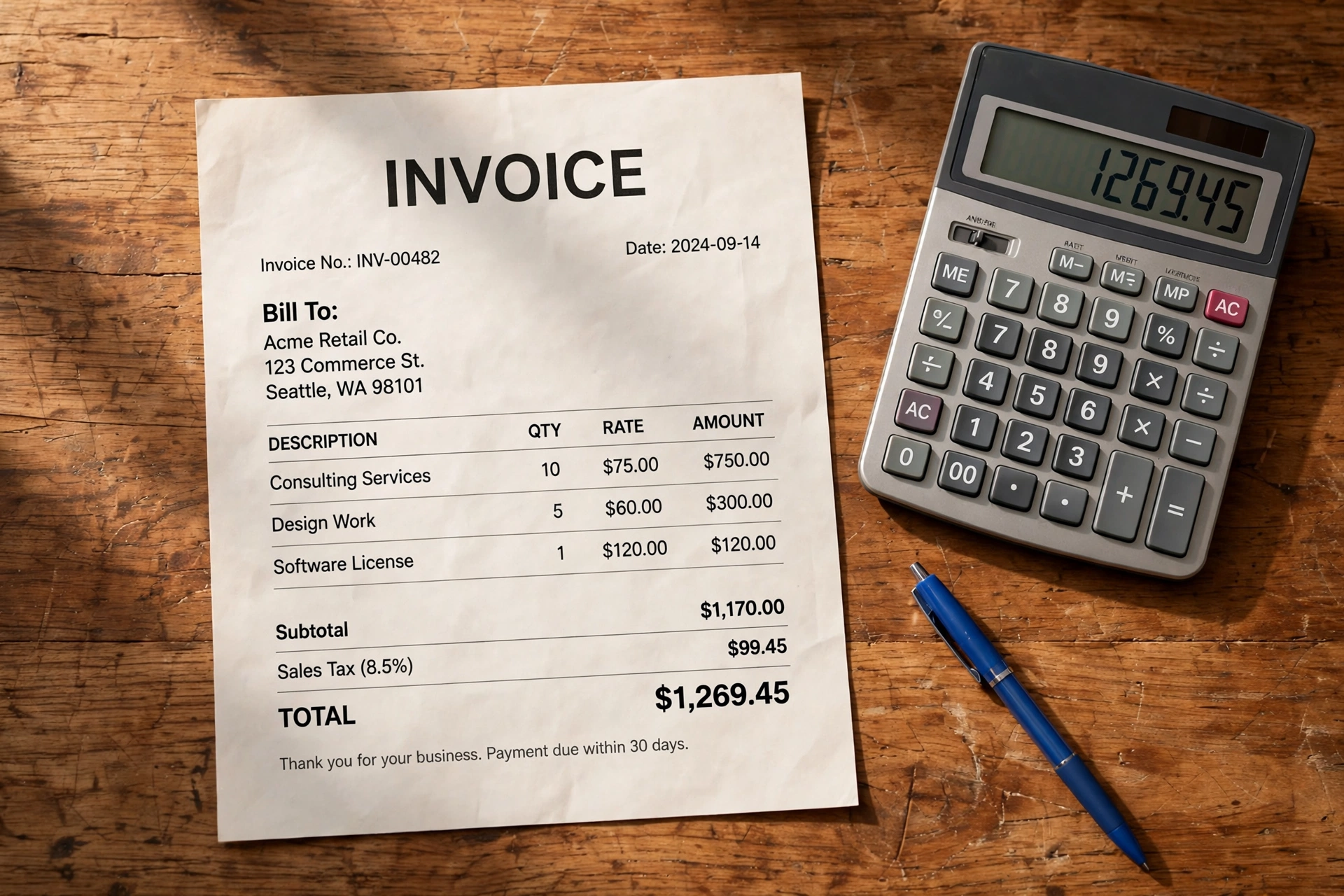
Here is a complete invoice for a freelance designer, showing every part of what to include on an invoice. Use it as a template for your own:
INVOICE
Maya Chen Design, 14 High Street, Bristol, maya@example.com, 07700 900123
Bill to: Green Leaf Café, 8 Market Square, Bristol, Accounts Department
Invoice number: INV-2026-042
Invoice date: 5 November 2026
Payment due: 5 December 2026 (Net 30)
Purchase order: PO-7781
Menu redesign — 1 × $400 = $400
Social media graphics, October — 6 × $50 = $300
Subtotal: $700
VAT (20%): $140
Total due: $840
Please pay by bank transfer to: Maya Chen Design, Account 12345678, Sort code 20-00-00, quoting invoice number INV-2026-042
Thank you for your business.
5 Common Invoice Mistakes (and How to Fix Them)
Mistake 1: No due date. Fix: always write a due date and a payment term in words. “Payment due: 5 December 2026 (Net 30)” leaves no room for argument.
Mistake 2: A vague description. Fix: rewrite the line so a stranger could understand it. If the line says “work done”, replace it with what was done, when, and for how long.
Mistake 3: No invoice number, or a reused number. Fix: start a simple numbering system today and never reuse a number. If you already sent two invoices with the same number, reissue one with a new number and a note explaining the correction.
Mistake 4: No payment instructions. Fix: add your bank details or payment link to every invoice, and test them once. An invoice without payment details is a request for an email exchange, not a request for payment.
Mistake 5: Maths the customer cannot follow. Fix: show every line, the subtotal, the tax, and the total, in that order. If you gave a discount or took a deposit, show those as their own lines too.
A Quick Checklist Before You Send
- The word “Invoice” is at the top.
- Your business and customer details are correct.
- The invoice number is unique.
- The invoice date and due date are both written out in full.
- Every line has a clear description, a quantity, a rate, and a total.
- Tax is shown as its own line, if it applies.
- The total due is easy to find.
- Payment instructions and payment terms are on the page.
- You have checked the maths once, line by line.

Frequently Asked Questions
Q: What is the minimum I must include on an invoice?
A: At a minimum, include your business details, your customer’s details, a unique invoice number, the invoice date, a description of the work, the amount due, and how to pay. Most tax authorities also require a due date and a tax breakdown, so check your local rules and add those too.
Q: Do I need to include my logo?
A: No, a logo is not required, but it helps. A logo makes your invoice look professional and easy to recognise. If you do not have a logo yet, a clear business name in a larger font works just as well. Never delay sending an invoice because you do not have a logo.
Q: Should I include payment terms on every invoice?
A: Yes. Write the payment term on every invoice, even for regular customers. Terms like “Net 30” or “Due on receipt” set a clear expectation and give you a fair basis for a reminder if payment is late. Without written terms, “late” is a matter of opinion. Payment terms are a small but important part of what to include on an invoice.
Q: Can I send an invoice without a business?
A: In many countries, yes — you can invoice as an individual or sole trader, using your own name and address. The parts of the invoice stay the same. Check your local tax and registration rules first, because some countries require a tax number once your income passes a threshold.
Q: What if my customer says something is missing?
A: Fix it fast and reissue the invoice with a note saying what changed, for example “Reissued 6 November 2026 — purchase order number added”. Keep the same invoice number if the amount did not change, and keep a copy of both versions. A quick, polite correction builds trust; an argument over a missing detail does not.
The Bottom Line
What to include on an invoice comes down to one idea: give the customer everything they need to pay you without asking a question. Your details, their details, a unique number, both dates, clear line items, tax, a bold total, and simple payment instructions — that is the complete checklist. If you want to skip the formatting and get straight to a finished invoice, you can create a free invoice with NexBillio’s free invoice generator — no sign-up, no watermark, and the PDF is ready to send in seconds. Fill in the parts above, check them once against the checklist, and send it with confidence.
2 thoughts on “What to Include on an Invoice: The Complete Checklist (With a Filled Example)”