

Sarah is a freelance web designer. Last month she finished a $10,000 project for a retail chain. She built the invoice in two minutes with our free invoice generator and sent it the same day — payment due in 30 days. Now she faces the invoice financing vs factoring question: wait a month, or turn the invoice into cash today?
The client is happy and the work is done. But Sarah’s rent is due next week, and her bank balance is $400. The $10,000 is real money — it is just sitting in someone else’s bank account.
Sarah has two ways to turn that unpaid invoice into cash: borrow against it, or sell it. The first is called invoice financing. The second is called invoice factoring. They sound almost the same, but they work differently, cost different amounts, and one puts a stranger in touch with your client.
This guide shows you exactly how each option works, what each one costs on the same $10,000 invoice, and which one is cheaper for your situation.
What Is Invoice Financing?
Invoice financing is a short-term loan that uses your unpaid invoices as security. You keep the invoice and the client relationship, and simply borrow against what your client owes you.
Here is how it works, step by step:
- You send your client an invoice for $10,000, due in 30 days.
- A financing company lends you most of it — usually 70 to 90 percent — within a day or two.
- Your client pays you as normal.
- You repay the loan, plus a fee, from that payment.
Your client never knows. Nothing changes for them — you still send the invoice, you still chase it if it is late, and the money still lands in your bank first.
The fee is usually 1 to 3 percent of the invoice value per month. On a $10,000 invoice at 1.5 percent, one month costs $150 — and if the client pays late, two months costs $300. How fast your client pays matters a lot.
Financing companies check your credit and business history, because you repay the loan. Weak credit can mean a refusal, or a higher rate. But if you are approved, financing is usually the cheaper option — and the only one that keeps your client relationship fully in your hands.
Ask for a deposit on bigger jobs, so some money is in your bank before the work starts. If a client pays late, our guide on how to chase an unpaid invoice has a five-step schedule.
What Is Invoice Factoring?
Invoice factoring is not a loan. You sell your unpaid invoice to a factoring company at a discount, and they give you most of its value straight away. The invoice now belongs to them — and so does the job of collecting it.
Here is how it works, step by step:
- You send your client an invoice for $10,000, due in 30 days.
- You sell it to a factoring company, which advances you 80 to 90 percent — say $8,500 — within a day or two.
- The factoring company contacts your client and collects the payment.
- When your client pays, the factoring company sends you the $1,500 it held back, minus its fee.
Your client will know: the factoring company tells them to pay a different bank account, and it sends the reminders. Most business clients accept this as normal. But if your relationship is personal, a call from a finance company can feel awkward.
The fee is usually 1 to 5 percent of the invoice value per month, according to NerdWallet’s guide to invoice factoring, plus possible setup or monthly-minimum charges. The exact fee depends on invoice size, sales volume, and how reliably your client pays. Our invoice factoring guide covers this option in more depth.
Check one thing before you sign: recourse or non-recourse. With recourse factoring, if your client never pays, you buy the invoice back — the loss is yours. With non-recourse factoring, the company takes the loss. Non-recourse costs more, but it protects you if a client goes bust.
Factoring is easier to get than financing. The company cares mostly about your client’s credit, not yours — your client is the one paying them. That makes it a real option for new businesses, or for owners with a weak credit score.

Invoice Financing vs Factoring: The Full Comparison
Here is the same choice, side by side — cost, control, and who talks to your client.
| Invoice Financing | Invoice Factoring | |
|---|---|---|
| Who owns the invoice? | You do — you borrow against it | The factoring company buys it |
| Who chases the client? | You do | The factoring company does |
| Is it a loan? | Yes — a loan secured by invoices | No — a sale of the invoice |
| Typical cost | 1–3% of invoice value per month | 1–5% of invoice value per month |
| Up-front amount | Usually 70–90% of the invoice | Usually 80–90% of the invoice |
| Credit check | Your credit and your business | Mainly your client’s credit |
| Does the client find out? | No — nothing changes for them | Yes — they pay the factoring company |
| Best for | Reliable clients, owners who want control | Businesses that cannot chase payments or get a loan |
| Risk if the client never pays | You still owe the loan | Recourse: you buy it back; non-recourse: the factor takes the loss |
| Extra fees to watch for | Origination fee, late-payment interest | Setup fee, monthly minimum, service fee |
Two rows matter most. The cost ranges overlap — a cheap factoring deal can beat an expensive financing deal, so compare real quotes, not labels. And the credit check decides who can apply: weak credit plus big, reliable clients can leave factoring as your only option.
Worked Example: Invoice Financing vs Factoring on the Same $10,000 Invoice
Numbers make the choice clear. Take one $10,000 invoice, due in 30 days, from a reliable client, and run it through both sides of invoice financing vs factoring. The advance rate is 85 percent in both cases.
Option 1 — Invoice financing:
- Invoice value: $10,000
- Cash you borrow today: 85% of $10,000 = $8,500
- Fee: 1.5% of $10,000 for one month = $150
- Client pays you $10,000 on day 30
- You repay the loan plus the fee: $8,500 + $150 = $8,650
- Money you keep in total: $10,000 − $150 = $9,850
- Total cost to you: $150
Option 2 — Invoice factoring:
- Invoice value: $10,000
- Cash advanced today: 85% of $10,000 = $8,500
- Money held back as a reserve: 15% of $10,000 = $1,500
- Fee: 3% of $10,000 for one month = $300
- Client pays the factoring company $10,000 on day 30
- Factoring company sends you the reserve minus the fee: $1,500 − $300 = $1,200
- Money you keep in total: $8,500 + $1,200 = $9,700
- Total cost to you: $300
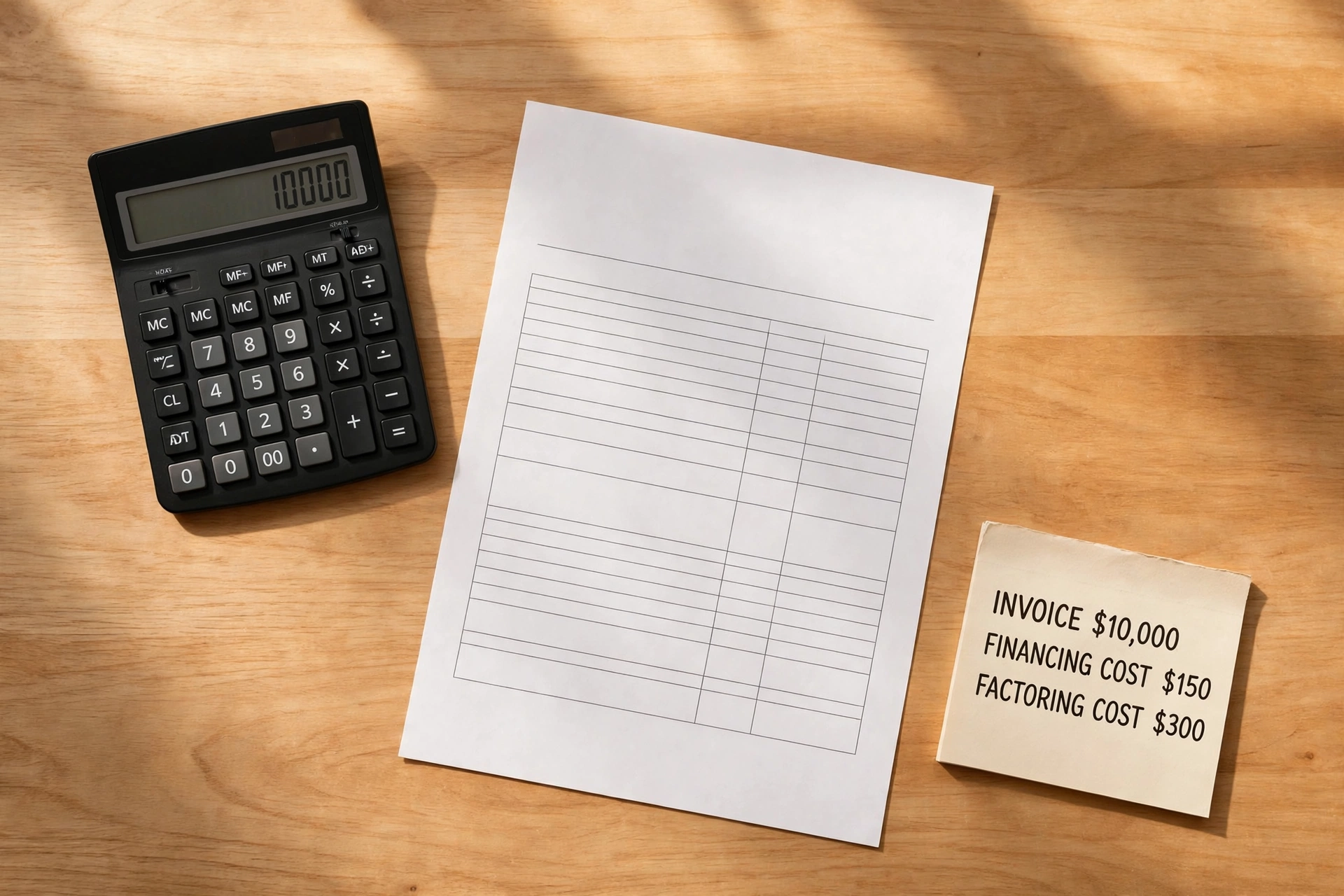
On this invoice, financing is cheaper by $150 — half the cost of factoring — because its fee rate (1.5 percent) is half the factoring rate (3 percent). Everything else is the same.
If the client pays 30 days late, both fees double: financing costs $300 (you keep $9,700), factoring costs $600 (you keep $9,400). Financing is still cheaper — but a slow-paying client makes either option expensive.
Invoice Financing vs Factoring: Which One Is Cheaper?
There is no single winner — it depends on your situation. But as a rule of thumb, in invoice financing vs factoring the cheaper option is usually financing, if your clients pay on time.
If your clients pay on time and you can get approved, invoice financing is usually cheaper. You keep control, the fee rate is usually lower, and the client never knows — the right choice for most established small businesses with reliable clients.
If you cannot get approved for financing, or you cannot chase payments yourself, invoice factoring is the better choice — even though it costs more. It turns the invoice into cash with no loan on your record, and the company does the chasing — worth the extra fee for a new business or a weak credit score.
If your clients are slow payers, neither option is cheap. Fees are charged per month, so every extra week eats into your money. Try the cheaper fixes first: put a late fee on the invoice, shorten your payment terms, and ask for a deposit on the next job. A late fee of 1.5 percent a month means paying you late now has a price.
Before you decide, get two real quotes: a 1 percent difference on a $10,000 invoice is $100 a month. Ask each provider for the total cost — advance, fee, and every extra charge — in writing. The cheapest headline rate is not always the cheapest deal.
5 Mistakes to Avoid (with Fixes)
Mistake 1 — Comparing only the headline rate. A provider quotes 1 percent a month, then adds a setup fee, a monthly minimum, and a wire fee. Fix: ask for the total cost in writing before you sign.
Mistake 2 — Factoring an invoice from a client who always pays late. Fees are charged per month, so a 60-day payment doubles your cost — and with recourse factoring, a client who never pays means you buy the invoice back. Fix: factor only invoices from clients who pay in 30 days.
Mistake 3 — Selling every invoice, every month. Factoring every invoice turns a one-off fix into a permanent cost: $300 a month on $10,000 of invoices at 3 percent — $3,600 a year — gone. Fix: use factoring for emergencies only, and fix the cause in between with shorter terms, deposits, and reminders.
Mistake 4 — Signing a recourse deal without knowing it. Many cheaper deals are recourse deals: if your client goes bust, the company hands the loss back to you. Fix: read the contract, find the word “recourse,” and ask what happens if the client never pays. If you cannot afford the loss, pay more for non-recourse — or pick financing.
Mistake 5 — Sending an incomplete invoice to the finance company. The company checks the invoice before it pays you — if the due date, client details, or a clear description of the work is missing, approval stalls for days. Fix: make every invoice complete before you send it. Our guide on what to include on an invoice is a short checklist — run through it once, and your invoices will pass first time.
Frequently Asked Questions
Does my client find out if I use invoice financing?
No. With financing, nothing changes for your client — you still send the invoice, they still pay you, and the loan is between you and the lender. With factoring, yes: the company contacts your client and tells them to pay a different account.
Is invoice financing a loan?
Yes. Invoice financing is a loan, or a line of credit, secured by your unpaid invoices — repaid, with a fee, when your client pays. Invoice factoring is not a loan: you sell the invoice, so there is nothing to repay and no loan on your record.
Does invoice factoring hurt my credit score?
Factoring does not usually hurt your credit — you are not borrowing money, and the company checks your client’s credit, not yours. But with a recourse deal, a client who never pays leaves you owing the company, so check whether your deal is recourse or non-recourse before you sign.
Can I factor just one invoice?
Yes. Most companies let you factor a single invoice, and many let you pick which ones to sell — you do not have to factor everything. Factoring one big invoice from a reliable client is the smartest way to try it.
What happens if my client never pays?
With financing, you still owe the loan — your client not paying does not cancel your debt. With recourse factoring, you must buy the invoice back. With non-recourse factoring, the company takes the loss. Read that clause before you sign.
The Short Version: Invoice Financing vs Factoring
Invoice financing vs factoring comes down to two questions: can you get approved, and do you want to keep control of your client? If your clients pay on time and you can get a loan, financing is usually cheaper — $150 against $300 on a $10,000 invoice paid in 30 days. If not, factoring costs more, but gets you cash with no loan and no chasing.
Whichever you pick, use it for a gap, not as a habit. The cheapest money is still the money your clients pay on time — and that starts with a clear invoice.
Ready to send one? Build your invoice in seconds with our free invoice generator — no sign-up, no watermark, PDF download straight away.
1 thought on “Invoice Financing vs Invoice Factoring: Which Is Cheaper?”