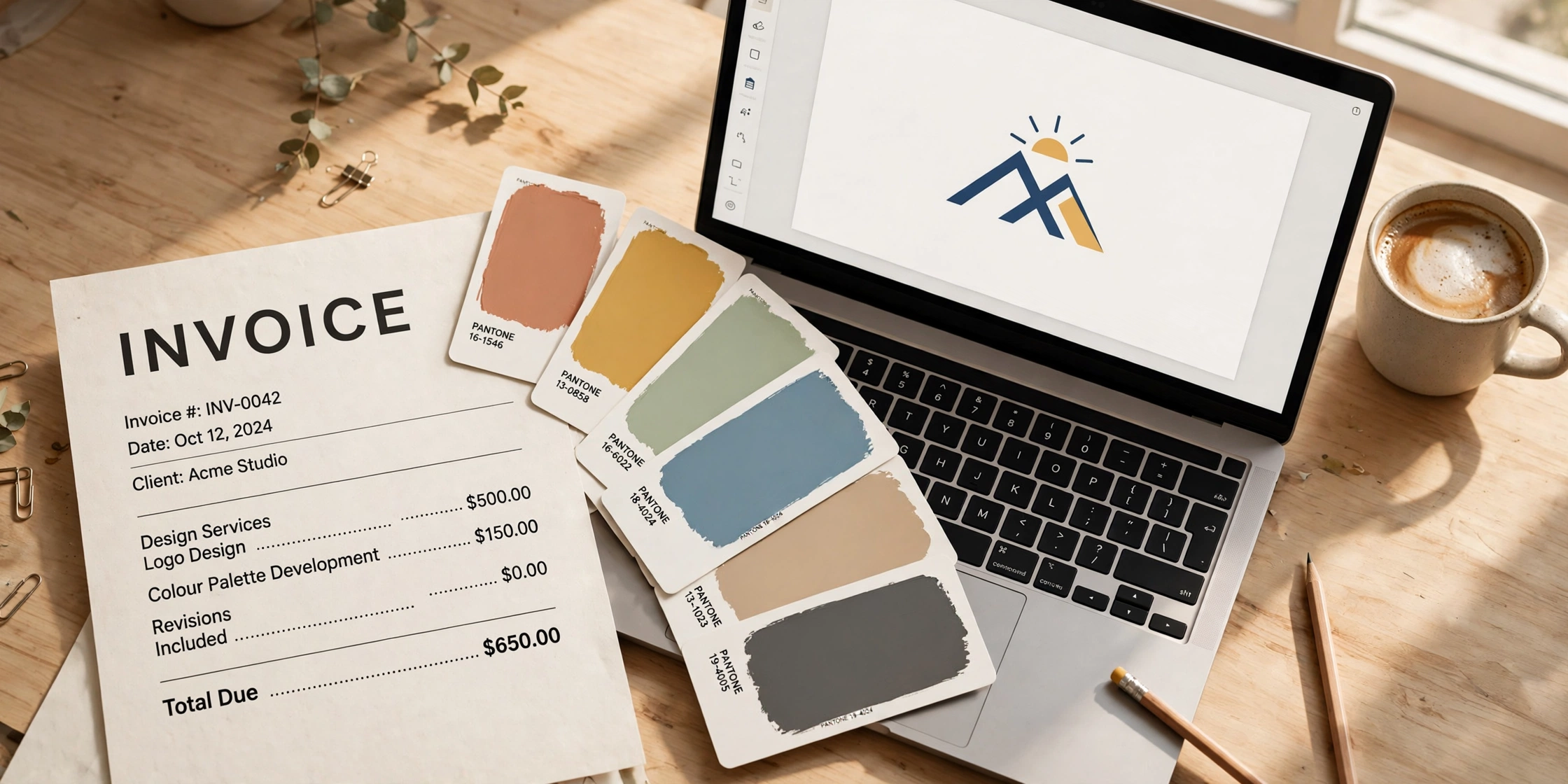
You finished the logo. The client loves it. You send the graphic designer invoice — and then the emails start. “Does this price include the source files?” “Can we use the logo on packaging too, or just the website?” “We thought two more revision rounds were included.”
None of that is a design problem. It is an invoice problem.
A graphic designer invoice is not just a bill for hours. It is the one document that says what the client bought, what they can do with the work, how many changes are included, and when the money is due. Get those four things in writing and most payment fights never start.
This guide shows you exactly what to put on a graphic designer invoice, how to handle licensing and revisions, when to ask for a deposit, and what a finished invoice looks like — with a full worked example you can copy.
What Is a Graphic Designer Invoice?
A graphic designer invoice is a bill a designer sends for creative work — logos, brand identity, social media graphics, packaging, web design, illustrations, or print layouts. Like any invoice, it lists who did the work, who pays, what was delivered, and how much is owed.
The difference is what sits between the line items. A plumber bills for parts and labour. A designer bills for ideas, files, and rights. The invoice has to describe the creative work clearly enough that a client who is not a designer understands what they are paying for — and what they are allowed to do with it afterwards.
That is why a good designer invoice has three sections most other invoices skip: a usage-rights (licensing) line, a revisions line, and a file-delivery line. We cover all three below.
If you are new to invoicing in general, start with the basics first — then come back here for the design-specific parts. what to include on an invoice
What to Include on a Graphic Designer Invoice
Every graphic designer invoice needs the standard fields, plus the design-specific ones. Here is the full checklist.
| Field | What to write | Why it matters |
|---|---|---|
| Your business name and contact | Name, email, phone, address | The client needs to know who to pay and how to reach you |
| Client name and contact | Company name, contact person, email | Stops the invoice landing with the wrong person |
| Invoice number | A unique number, e.g. GD-2026-014 | Lets you and the client track payment |
| Invoice date and due date | Date sent + date payment is due | Sets the payment clock running |
| Project description | Project name, e.g. “Logo + brand kit for Bloom Bakery” | The client must recognise the work at a glance |
| Line items | Each deliverable on its own line, with price | No lump-sum mystery totals |
| Licensing / usage rights | What the client may use, where, and for how long | Prevents “we thought we owned everything” disputes |
| Revisions included | Number of revision rounds in the price | Stops endless free changes |
| Deposit paid / balance due | Deposit already received, amount still owed | Shows the real balance, not the full price |
| Payment terms | Net 14, Net 30, or due on receipt | Tells the client exactly when to pay |
| Payment methods | Bank transfer, PayPal, card | Fewer excuses for late payment |
| Tax | Sales tax or VAT if it applies | Keeps you legal |
| Total due | One clear number, in bold | The client should never have to add it up |
Miss the licensing line and you will argue about it later. Miss the revisions line and you will work for free. Miss the deposit line and the client may pay the full amount twice — or not at all.
How to Price Design Work on an Invoice
Designers usually bill one of three ways. Each one looks different on the invoice.
Hourly billing. You charge for time: “Logo design — 8 hours × $75 = $600.” Good for open-ended work like ongoing social media design, where the scope keeps changing. The risk is that clients watch the clock and question every hour, so list the hours honestly and keep a short note of what each block covered.
Flat project fee. One price for one outcome: “Brand identity package — $2,400.” Most clients prefer this because they know the total before work starts. On the invoice, break the flat fee into its parts anyway — logo $900, colour palette $300, brand guidelines $600, social templates $600 — so the client sees the value instead of one big number.
Per-item or per-deliverable. A price for each thing: “Instagram post set (10 graphics) — $350.” Good for repeat work with a fixed menu of deliverables.
| Billing method | Best for | Invoice looks like | Watch out for |
|---|---|---|---|
| Hourly | Ongoing or unclear scope | Hours × rate per line | Clients questioning the hours |
| Flat project fee | Logos, brand kits, websites | One total, broken into parts | Scope creep without a revisions cap |
| Per deliverable | Repeat graphics, social packs | Price per item, quantity shown | Clients adding items mid-project |
Whichever method you use, the invoice should show the maths. A client who can follow the numbers pays faster than one who has to trust them.
Licensing and Usage Rights: The Line Most Designers Forget
This is the part that causes the most expensive arguments in design work — and the part most designer invoices leave out completely.
When a client pays for a logo, what exactly did they buy? The right to use it on their website? On packaging? On a billboard? Forever, or for one year? Can they change the colours? Can they sell merchandise with it on?
If the invoice says nothing, both sides guess — and they guess differently.
Put one clear licensing line on every invoice. For example: “Licence: full commercial use of the final logo files for Bloom Bakery, all media, unlimited time. Source files (.AI) included. Designer keeps the right to show the work in their portfolio.”
Or, for a smaller job: “Licence: use of the 10 social media graphics on Instagram and Facebook for 12 months. No resale or transfer to third parties.”
Two common licence types:
- Full buyout. The client owns the work outright and can use it anywhere, forever. Charge more for this — you are giving up future income from that design.
- Limited licence. The client can use the work in named places, for a named time. Cheaper for the client, and you can charge again if they want wider use later.
A real example: a designer charged $800 for a logo with a limited licence (website + social media, one year). Six months later the client wanted the logo on product packaging — outside the licence. The designer charged $400 for the extended licence. If the invoice had said “full use, forever” for the same $800, that $400 would never have existed.
State the licence on the invoice, not just in an email. The invoice is the document both sides keep.

Deposits and Revisions: Protect Your Time Before You Start
Two numbers protect a freelancer designer more than any other: the deposit and the revision limit.
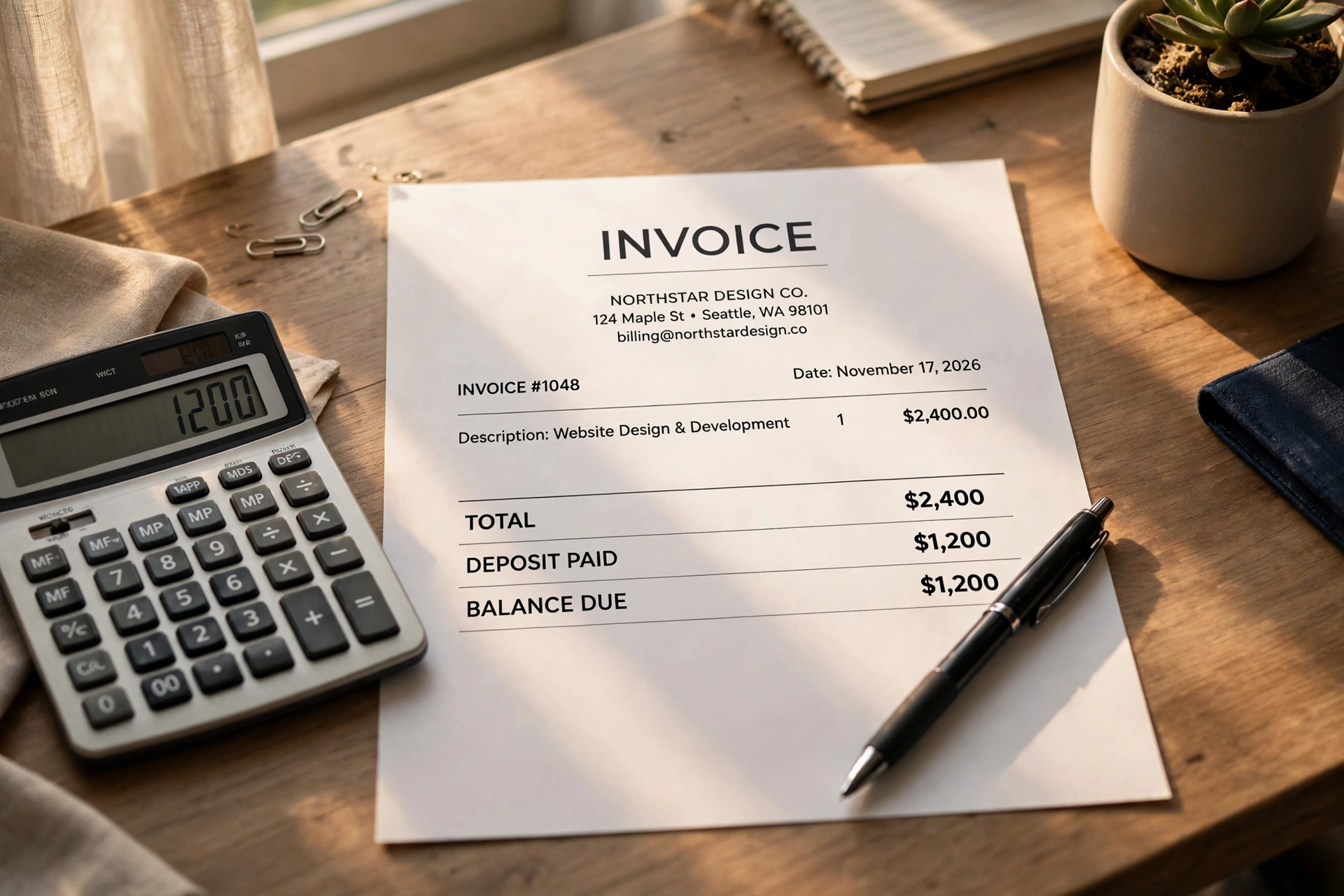
Ask for a deposit. 50% up front is the standard for design work, and it is fair: you are reserving days of your time for one client. Put it on the invoice as its own line: “Deposit received 1 Nov 2026 — $1,200. Balance due on delivery — $1,200.” The final invoice then shows the balance, not the full price, so the client never accidentally pays twice. deposit invoice
No deposit, no start. That rule sounds harsh until the first time a client cancels after you spent a week on concepts. A deposit also filters out clients who were never serious.
Cap the revisions. “Two revision rounds included” is the industry standard. One round means the client sends all their changes at once, you revise, and that is round one. A second round polishes it. A third round is new work — charge for it, usually at your hourly rate.
Write it on the invoice: “Revisions included: 2 rounds. Extra rounds at $75/hour.” When a client asks for round four, you do not argue. You point at the invoice.
A quick note on deposits and the law: a deposit is normal business practice for creative work. What matters is that the amount and the terms are written down before work starts — on the quote and again on the invoice — so nobody can claim they did not agree.
Worked Example: A Complete Graphic Designer Invoice
Here is a full example. A designer, Maya, creates a brand identity package for a small bakery. Flat fee $2,400. Deposit 50% ($1,200) paid up front. Two revision rounds included. Full commercial licence.
Invoice GD-2026-014 — Maya Designs to Bloom Bakery — 14 Nov 2026
| Line item | Amount |
|---|---|
| Logo design (primary + 2 variations) | $900 |
| Colour palette + typography guide | $300 |
| Brand guidelines document (12 pages) | $600 |
| Social media templates (10 designs) | $600 |
| Subtotal | $2,400 |
| Deposit paid 1 Nov 2026 | −$1,200 |
| Total due | $1,200 |
Licence: full commercial use of all final files for Bloom Bakery, all media, unlimited time. Source files (.AI, .PSD) included. Designer keeps portfolio rights.
Revisions included: 2 rounds (both used). Extra rounds at $75/hour.
Payment terms: Net 14 — due 28 Nov 2026. Bank transfer or PayPal.
Notice what the client sees: every deliverable priced, the deposit already taken off, one clear total, and the licence and revision terms in plain words. Nothing to argue about, nothing to email back and ask.
Now compare that with the invoice most new designers send: one line — “Design work — $1,200” — and no licence, no revisions, no deposit line. Same designer, same work, same client. The first invoice gets paid in a week. The second one starts a three-week email argument.
5 Mistakes Designers Make on Invoices (and the Fix for Each)
Mistake 1: One lump-sum line for everything. “Design work — $2,400.” The client cannot see what they bought, so they haggle over the whole number. Fix: break every deliverable onto its own line with its own price.
Mistake 2: No licence line. The client assumes they own everything, forever, in every medium. You assume they bought one use. Both of you are wrong in the other’s eyes. Fix: one sentence on every invoice stating what the client may use, where, and for how long.
Mistake 3: Unlimited revisions. “Happy to tweak until you’re happy!” sounds friendly. It means twenty rounds of changes for the price of two. Fix: state the number of included rounds and your hourly rate for extra ones — on the invoice, not just in chat.
Mistake 4: No deposit, no start date. You do the work, send the invoice, and the client goes quiet for six weeks. Fix: 50% up front, shown as a line on the final invoice so the balance is obvious.
Mistake 5: Sending a PDF with no payment link or clear due date. The client has to ask how to pay and by when. Every question is a delay. Fix: due date in bold, payment methods listed, and a payment link if your tool supports one. how to chase an unpaid invoice payment reminder email templates
How to Send It and Get Paid Faster
Sending the invoice is a five-minute job when the template is ready. Do it the same day the work is delivered, while the client is happiest with it.
- Export the invoice as a PDF from your invoice tool — never send an editable file the client can change.
- Write a short email with it. Two lines are enough: what the invoice is for, and when it is due. “Hi Sara, attached is the final invoice for the Bloom Bakery brand package. The balance of $1,200 is due by 28 Nov. Thank you!”
- Name the file clearly — “Invoice-GD-2026-014-Bloom-Bakery.pdf” — so the client can find it again.
- Set a reminder for the day after the due date. If it is unpaid, send a polite nudge the next morning. Most late payments are forgetfulness, not refusal.
- Keep every invoice numbered and filed. When a client asks “did I pay that?” in six months, you want the answer in thirty seconds.
A free invoice generator does steps 1 and 3 for you: fill in the lines, add the licence note, download the PDF. free invoice generator
FAQ
Do I need to charge sales tax on design work? It depends on where you live and where the client is. In the US, most states do not tax pure design services, but some tax digital products. In the UK and EU, VAT usually applies to design services. Check your local rules — and when in doubt, ask an accountant rather than guessing on an invoice. IRS Small Business Tax Center
Should I give the client the source files? Only if the licence says so — and charge for it. Source files (.AI, .PSD, .Figma) let the client edit your work or hand it to another designer. Many designers include them in a full buyout and charge extra for them on a limited licence. Whatever you decide, write it on the invoice.
How much deposit should I ask for? 50% is the standard for design work. For very large projects, split it: 50% to start, 25% at first draft, 25% on delivery. For tiny jobs under $200, full payment up front is reasonable.
What if the client keeps asking for more revisions? Point at the invoice. “Two rounds were included and both are used — extra rounds are $75 an hour, and I’m happy to keep going.” Clients respect a boundary that was written down before the work started. They resent one invented halfway through.
Can I invoice as an individual, without a registered business? Yes — in most countries you can invoice as an individual or sole trader using your own name. Put your name where a business name would go and keep records for tax time. invoice without a business
The Short Version
A graphic designer invoice is a bill, a licence, and a boundary in one document. List every deliverable on its own line. Write the licence in one plain sentence. Cap the revisions. Take a 50% deposit and show it on the final invoice. Give one clear total and one clear due date.
Do that, and the invoice stops being the start of an argument — it becomes the end of one. Build your next designer invoice in seconds with the free invoice generator — no sign-up, no watermark. free invoice generator
1 thought on “Graphic Designer Invoice: What to Include (Deposits, Revisions, Usage Rights)”