

A buyer sends one document before the work starts. A seller sends another document after the work is done. Both documents talk about the same order, the same goods, and the same amount of money — but they are not the same thing. Mix them up and you get slow payments, disputed amounts, and confused bookkeeping. That is the purchase order vs invoice difference in a nutshell.
This guide explains the purchase order vs invoice difference in plain words: who sends each one, what each one does, when you need one, and how the two fit together from order to payment. There is a worked example with real numbers, so you can see the whole flow from start to finish.
What Is a Purchase Order?
A purchase order, often shortened to PO, is a document a buyer sends to a seller before anything is delivered. It says: “We want to buy this, in this amount, at this price, by this date.” It is the buyer’s official order.
Think of a small cafe that needs 40 chairs. The cafe owner does not just phone the supplier and hope for the best. She sends a purchase order that lists the chairs, the quantity, the agreed price per chair, the delivery address, and the date she needs them. The supplier reads it, agrees, and starts the work. Both sides now have the same order in writing.
A purchase order usually includes:
- The buyer’s name, address, and contact details
- The seller’s name and address
- A purchase order number (for example, PO-2026-118)
- The date the order was placed
- A description of each item, with quantity and unit price
- The total amount, including any tax or delivery charges
- The delivery date and delivery address
- The payment terms the buyer expects
A purchase order is not a bill. Nobody owes money when a purchase order is sent. It is a promise to buy, and a record of exactly what was agreed. QuickBooks explains purchase orders as a formal written agreement that protects both sides, and that is exactly how to think of one. If the goods arrive wrong — the wrong chairs, the wrong quantity, the wrong price — the buyer can point at the purchase order and say, “This is not what we agreed.”
You can also read the official invoicing guidance for the rules on what an invoice must include.
Large companies almost always use purchase orders. They need a paper trail before money moves, and their finance team will not pay a bill that has no matching purchase order. Small businesses use them too, whenever an order is large enough that a mistake would hurt.
What Is an Invoice?
An invoice is a document a seller sends to a buyer after the goods or services have been delivered. It says: “Here is what we delivered, and here is what you owe us.” It is the seller’s request for payment.
Using the same cafe example: the supplier delivers the 40 chairs, then sends an invoice. The invoice lists the same chairs, the same quantity, the same price, and the total the cafe now owes. It also gives a due date — the day the money must arrive.
A good invoice format always includes:
- The seller’s business name, address, and contact details
- The buyer’s name and address
- A unique invoice number and the invoice date
- A description of each item, with quantity and price
- The total amount due, with tax shown separately
- The payment terms (for example, Net 30 means pay within 30 days)
- How to pay (bank transfer, card, or another method)
An invoice is a bill. Once it is sent, the buyer owes that money. It is also the seller’s main record for tax and bookkeeping — every sale should have an invoice behind it.
If you sell goods or services, you will send invoices all the time. A free invoice generator can build one in a minute, with the numbering, the totals, and the tax worked out for you — no sign-up needed.
Purchase Order vs Invoice: The Key Differences
The two documents look alike — both list items, quantities, prices, and totals. The differences are in who sends them, when they are sent, and what they mean. The purchase order vs invoice comparison below shows the differences side by side.
| Purchase order | Invoice | |
|---|---|---|
| Who sends it | The buyer | The seller |
| When it is sent | Before delivery, when the order is placed | After delivery, when payment is due |
| What it means | “We want to buy this” | “You owe us this” |
| Money owed? | No — nothing is owed yet | Yes — the amount is now due |
| Main purpose | To agree the order in writing | To ask for payment |
| Number | PO number (for example, PO-2026-118) | Invoice number (for example, INV-2026-1042) |
| Who keeps a copy | Buyer’s finance team and the seller | Seller’s records and the buyer |
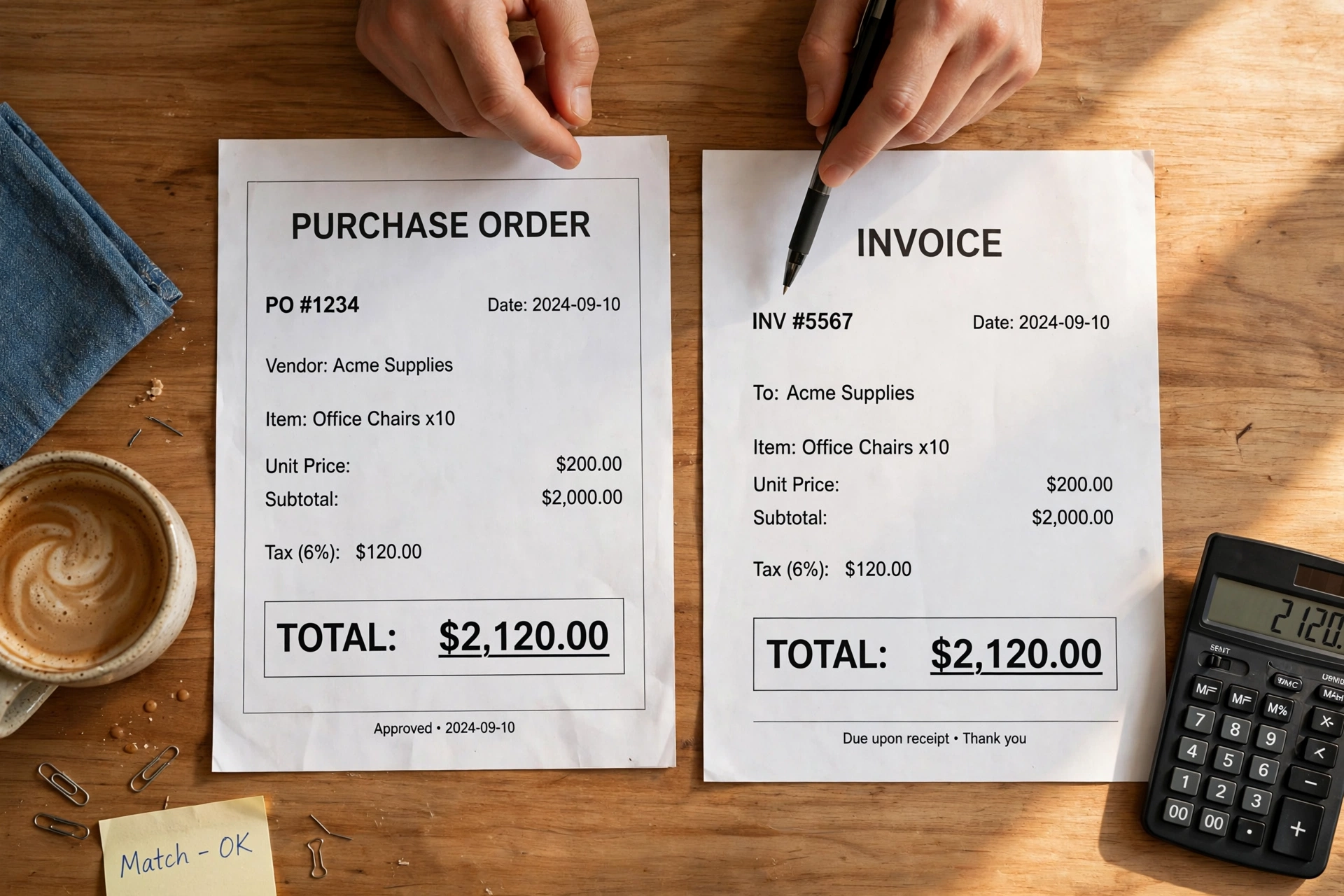
Here is the simplest way to remember it: the purchase order starts the deal, and the invoice ends it. The buyer writes the first document, the seller writes the last one. If you only ever see one of them, you are probably the seller — small sellers often never receive a purchase order at all, because their customers just place an order by email or phone. But the moment a bigger client asks for one, you need to know what it is.
How They Work Together: The Order-to-Pay Flow
A purchase order and an invoice are two steps in one flow. Here is how a normal business order moves from start to finish. This purchase order vs invoice flow is the same in almost every business-to-business sale.
Step 1: The buyer creates a purchase order. The buyer decides what they need and writes it down: items, quantities, prices, delivery date. They give it a PO number and send it to the seller. This is the order.
Step 2: The seller confirms the order. The seller checks the purchase order. If everything is right — the price, the quantity, the date — they accept it. If something is wrong, they ask for a corrected purchase order before doing any work. This step is where most expensive mistakes are caught.
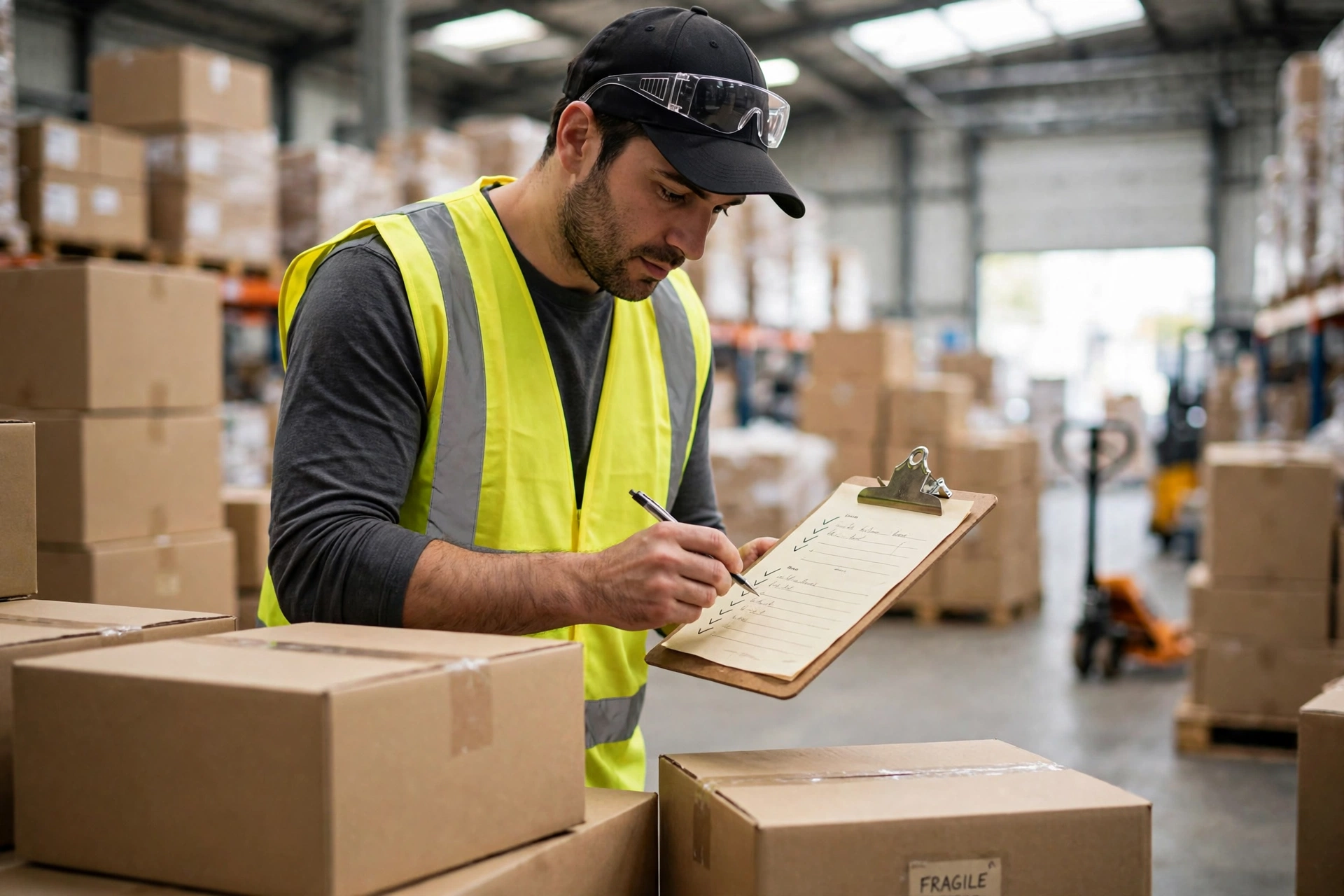
Step 3: The seller delivers the goods or services. The work happens. The chairs are made and delivered, or the service is completed. A delivery note or packing list often travels with the goods, and it should match the purchase order line for line.
Step 4: The seller sends the invoice. After delivery, the seller sends an invoice. The invoice should match the purchase order: same items, same quantities, same prices. A clear invoice numbering system helps here, because the buyer will check the invoice number against their own records.
Step 5: The buyer checks and pays. The buyer compares three documents: the purchase order, the delivery note, and the invoice. If all three agree, the payment is approved. This check is called three-way matching, and it is the reason big companies insist on purchase orders — it stops them paying for goods they never received, or paying the wrong amount. Once the check passes, the buyer pays by the due date on the invoice, under the agreed payment terms.
If any of the three documents disagree, payment stops until someone fixes it. That is the whole point of the system: no surprises, no overpayments, and a clear record for both sides.
Keep a copy of every document in the flow. The buyer keeps the purchase order and the invoice; the seller keeps the same two, plus the delivery note. If a payment is questioned months later — a common problem when a client changes staff — those three documents settle the argument in minutes. Paper copies work, but a simple folder on your computer, named by order number, is easier to search. Whatever you use, file the documents the day they arrive, not at the end of the month when the details have gone cold.
Worked Example: 40 Chairs, One Order, One Invoice
Here is the full flow with real numbers, so you can see how the two documents line up. This purchase order vs invoice example uses one order from start to finish.
The purchase order (sent by the buyer, 3 March 2026)
Cafe Luna sends PO-2026-118 to Northwood Furniture:
- 40 wooden chairs at $85 each = $3,400.00
- Delivery charge = $120.00
- Tax (8%) = $281.60
- Total on the purchase order = $3,801.60
- Delivery by 20 March 2026, to 14 Market Street
- Payment terms: Net 30 from invoice date
The delivery (20 March 2026)
Northwood Furniture delivers 40 chairs to 14 Market Street. The delivery note says 40 chairs, matching the purchase order exactly.
The invoice (sent by the seller, 20 March 2026)
Northwood Furniture sends invoice INV-2026-1042 to Cafe Luna:
- 40 wooden chairs at $85 each = $3,400.00
- Delivery charge = $120.00
- Tax (8%) = $281.60
- Total due = $3,801.60
- Due date: 19 April 2026 (Net 30)
Cafe Luna’s finance team compares the three documents. The purchase order says $3,801.60. The delivery note says 40 chairs. The invoice says $3,801.60. All three agree, so the payment is approved and $3,801.60 is paid on 15 April, four days early.
Now imagine the invoice had said $4,100 instead. The buyer would spot the difference at once, hold the payment, and ask the seller to fix the invoice. Without the purchase order, the buyer would have nothing to check the invoice against — and a $298.40 overcharge might have slipped through.
Common Mistakes (and How to Fix Them)
Mistake 1: Sending an invoice that does not match the purchase order. The prices or quantities differ, and the buyer’s finance team holds the payment. Fix: copy the items, quantities, and prices from the purchase order onto the invoice, line by line. Check the totals before you send it.
Mistake 2: No purchase order number on the invoice. The buyer cannot match your invoice to their order, so it sits in a pile while someone asks what it is for. Fix: always ask the buyer for their PO number and print it on the invoice, usually near the top. If there is no purchase order, say so clearly.
Mistake 3: Invoicing before delivery. You send the invoice the day the order is placed, and the buyer refuses to pay for goods they have not received. Fix: send the invoice after delivery, or after the service is done — unless your contract says otherwise, such as a deposit invoice for part of the amount up front.
Mistake 4: Using the same number twice. Two invoices share a number, or a purchase order number is reused, and the records become a mess. Fix: number every document in sequence and never reuse a number. If you need a system that scales, our invoice numbering systems guide shows six formats that work for growing businesses.
Mistake 5: No payment terms on either document. The purchase order says nothing about when to pay, and the invoice says nothing either, so nobody knows the deadline. Fix: put the payment terms on both documents. Net 30 is the most common choice for business-to-business work — our guide to what Net 30 means explains how it works.
Mistake 6: Treating a purchase order as a paid invoice. A new seller sees a purchase order for $3,801.60 and records it as money earned. It is not — no money is owed until the goods are delivered and the invoice is sent. Fix: record purchase orders as orders, not income. Count the money only when the invoice goes out.
Do Small Businesses Need Purchase Orders?
Not always. If you are a freelancer or a small shop, most of your customers will simply order by email, phone, or a message — and that is fine for small jobs. A written order, even a short email that lists the items and the price, does the same job as a formal purchase order for a $200 job.
But use a purchase order when any of these are true:
- The order is large — a mistake would cost real money
- The buyer is a company with a finance team (they may require one before they pay)
- The order has many items, or delivery is spread over several dates
- You are ordering goods for a client and need proof of what was agreed
- The goods are made to order and cannot be returned
If a big client sends you a purchase order, treat it as good news: it means they are organized, they have a budget approved, and they will pay once you deliver and invoice correctly. Just make sure your invoice matches their purchase order exactly.
For international orders, the paperwork grows: a commercial invoice is a separate document used by customs, and it lists the goods, their value, and the buyer and seller for export. Do not confuse it with a normal sales invoice — it serves a different purpose.
Frequently Asked Questions
Is a purchase order the same as an invoice?
No. A purchase order is sent by the buyer before delivery to place the order. An invoice is sent by the seller after delivery to ask for payment. They describe the same order, but they are different documents with different jobs.
Who sends the purchase order, the buyer or the seller?
The buyer sends the purchase order. The seller receives it, confirms it, delivers the goods or services, and then sends the invoice back to the buyer.
Can I invoice without a purchase order?
Yes. Most small sales happen without a purchase order — the customer orders, you deliver, and you invoice. A purchase order is only needed when the buyer wants a formal written order, usually for larger amounts or company purchases.
What should I do if my invoice does not match the purchase order?
Fix the invoice before the buyer finds the difference. Check the items, quantities, unit prices, and totals against the purchase order, correct the mistake, and send a revised invoice with a note explaining what changed. Never ask the buyer to pay a different amount than the one they agreed to.
What is three-way matching?
Three-way matching is the check a buyer’s finance team does before paying: they compare the purchase order, the delivery note, and the invoice. If all three agree on the items, quantities, and total, the payment is approved. If anything disagrees, payment is held until it is fixed.
Does a purchase order mean I will definitely get paid?
No, but it helps a lot. A purchase order proves the buyer agreed to the order and the price, and most companies will not pay without one. You still need to deliver what was ordered, send a correct invoice, and follow up if the payment is late — our guide on chasing an unpaid invoice shows the steps if the money does not arrive.
The Short Version
A purchase order is the buyer saying “we want to buy this.” An invoice is the seller saying “here is what you owe.” The purchase order comes first, the invoice comes last, and the two should match each other exactly. Keep both documents, number them in sequence, and check every invoice against the purchase order before you send it. That is the whole purchase order vs invoice story in one paragraph.
If you need to send the invoice side of the deal, our free invoice generator builds a clean, professional invoice in about a minute — no sign-up, no watermark, and you can download it as a PDF straight away.
1 thought on “Purchase Order vs Invoice: The Full Order-to-Pay Flow Explained”