
You are busy. Jobs are coming in, clients are happy, and sales look good. Then rent is due, a supplier wants paying, and your bank balance says no. These small business cash flow tips fix that.
That is a cash flow problem. The work is there — the money is just arriving too late, or not at all.
The good news: most cash flow problems start with invoices, so they can be fixed with invoices too. These 12 small business cash flow tips are simple changes to how you invoice, chase, and plan — no loan, no new software, no accountant needed.
What Cash Flow Really Means
Cash flow is simple: money in, money out, and when each one happens.
Profit is what you earn over a whole year. Cash flow is whether you have enough money in the bank this week. A business can be profitable on paper and still run out of cash, because the money it is owed arrives a month after the bills are due.
Think of it like a tap and a drain. Your invoices are the tap. Your rent, materials, and wages are the drain. If the tap runs slowly and the drain runs fast, the tank empties — even if the total over the year is fine.
Small Business Cash Flow Tips to Get Paid Faster
The first four small business cash flow tips are about speed. Every day you wait to invoice is a day your money sits in someone else’s bank account.
1. Invoice the same day you finish the work
Many small businesses finish a job on Monday and send the invoice on Friday — or next month. That delay costs you a full payment cycle.
Send the invoice the same day the work is done, while the job is fresh in the client’s mind. A client who has just received good work pays fast. One who gets the invoice three weeks later has to think about it first — and thinking takes time.
If you use a free invoice generator, an invoice takes two minutes to build and send. There is no reason to wait.
2. Shorten your payment terms
Net 30 means “pay me in 30 days” — a month of waiting. For most small jobs, Net 14 or Net 7 is fair, and most clients will accept it if you ask.
Look at your last ten invoices. If most clients paid in 25 to 30 days, changing the terms to Net 14 can bring your money in two weeks earlier. On $5,000 of monthly work, that is $5,000 in your bank two weeks sooner, every single month.
3. Ask for a deposit on bigger jobs
A deposit is money in before the work starts. On any job over $500, ask for 25% to 50% up front. It covers your materials, proves the client is serious, and smooths out the month.
A web designer charging $3,000 asks for $1,500 before starting; a contractor asks for 30% to buy materials. Both have cash in the bank while they work.
4. Give clients more ways to pay
Every extra step between “invoice received” and “money sent” loses you payments. If the only way to pay is a bank transfer the client must set up by hand, some will put it off for a week.
Add a card payment link or a “Pay Now” button to the invoice, and put your bank details right on the page — not buried in an email thread. The easier it is to pay, the faster it happens.

Stop Late Payments
The next four small business cash flow tips are about clients who pay late — or never. Late payment is the biggest cash flow killer for small businesses, and it is mostly preventable.
5. Send a reminder before the due date
Do not wait until an invoice is overdue. Send a short, friendly reminder two or three days before the due date: “Just a quick note — invoice 104 for $850 is due on Friday.”
Most late payments are not refusals — they are forgotten invoices. A reminder before the due date catches the honest forgetters and costs you nothing. Our payment reminder email templates give you copy-paste wording for before, on, and after the due date.
6. Put a late fee on the invoice — and mean it
A late fee changes the maths for the client. Without one, paying you late costs them nothing, so your invoice goes to the bottom of the pile. With a fee of 1.5% a month, late payment has a price — and your invoice moves up.
Write the fee on the invoice itself, in plain words: “A late fee of 1.5% per month applies to overdue amounts.” Then charge it when it applies. A fee you never charge is just decoration.
7. Chase overdue invoices on a fixed schedule
Decide your schedule once and follow it every time: a polite reminder on the due date, a firmer email at 7 days overdue, a phone call at 14 days, and a final notice at 30 days.
Write the schedule down and stick to it — businesses that chase on a schedule get paid weeks earlier than businesses that chase “when they remember.” Our guide on how to chase an unpaid invoice has the full five-step escalation, with final notice templates.
8. Stop work for serial late payers
Some clients pay late every single time — each late payment is a loan you never agreed to give. Change the deal: payment up front, a deposit on every job, or shorter terms — or stop working with them.
It feels hard to turn work away. But a client who pays 60 days late on a $2,000 job has cost you two months of cash flow — time better spent on a client who pays in 7 days.
Smooth Out the Gaps
The last four small business cash flow tips are about planning. Even with fast payments, income and bills both come in lumps — the fix is to spread both out.
9. Use recurring invoices for regular clients
If a client pays you every month — a retainer, a monthly service, a regular clean — set up a recurring invoice that goes out on the same day each month. No writing, no forgetting.
Regular income is the best cash flow medicine there is. Three clients on $500 monthly retainers is $1,500 you can count on, every month. Our guide to recurring invoices explains how to set them up.
10. Offer a small discount for early payment — only when it pays
“2% off if you pay within 10 days” works, but it costs you money. Use it only when fast cash is worth more than the discount. On a $1,000 invoice, 2% is $20 — cheap if it brings the money in 20 days early and keeps your rent paid.
Never offer early-payment discounts as a habit on every invoice. Save it for big invoices, slow months, or clients you know pay slowly.
11. Match your own bills to your income
You cannot always change when clients pay — but you can often change when you pay. Ask your biggest suppliers for longer terms, or move a monthly bill to the week your biggest client usually pays.
List your regular bills by date, and your expected payments by date. If rent and a supplier bill both land in week one but your money arrives in week three, ask one supplier to move to week three. One phone call can close a gap that used to cause a crisis every month.
12. Keep a four-week cash flow forecast
This is the fix that makes all the others work. Once a week, spend ten minutes on a simple forecast: money you expect in and money you must pay out, for each of the next four weeks.
You do not need software — a notebook works. The point is to see the gap before it arrives: a $900 shortfall in week three is easy to fix today, and a crisis when it is already here. Update it every Monday.
Worked Example: One Month of Cash Flow
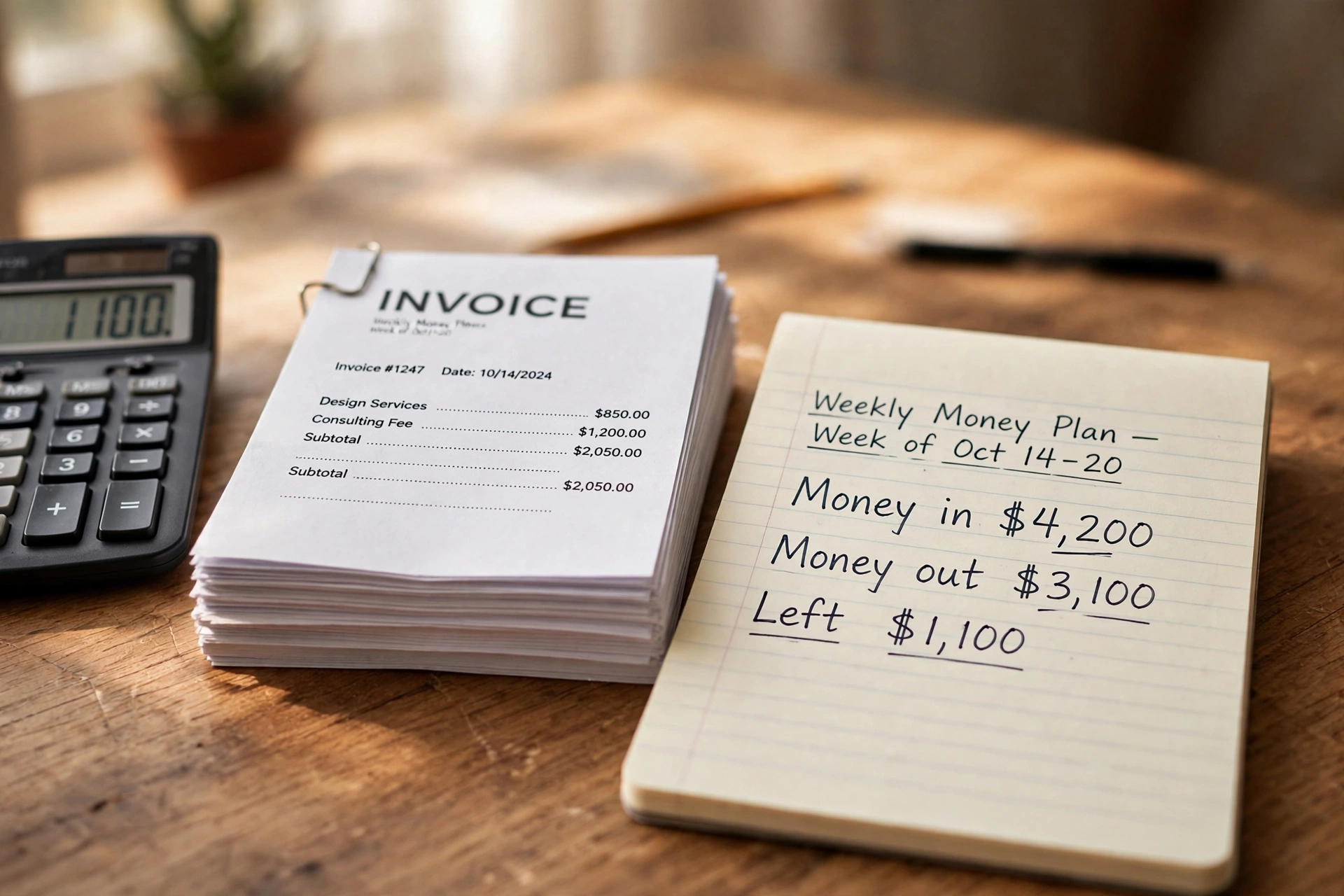
Maya runs a small design studio. She bills about $4,200 a month. Her costs — rent, software, and a part-time assistant — come to $3,100. On paper she makes $1,100 a month. But last month she nearly missed rent. Here is how these small business cash flow tips change her month.
Before — invoices sent late, Net 30, no reminders:
| Week | Money in | Money out | Balance |
|---|---|---|---|
| Week 1 | $0 | $1,400 (rent + software) | -$1,400 |
| Week 2 | $900 | $600 (assistant) | -$1,100 |
| Week 3 | $1,200 | $500 (materials) | -$400 |
| Week 4 | $2,100 | $600 (assistant) | $1,100 |
Maya ended the month fine — but weeks 1 to 3 were negative, and one late payment in week 4 would have meant missing rent.
After — same-day invoicing, Net 14, a 50% deposit on the big job, and a reminder before the due date:
| Week | Money in | Money out | Balance |
|---|---|---|---|
| Week 1 | $1,500 (deposit) | $1,400 (rent + software) | $100 |
| Week 2 | $1,200 | $600 (assistant) | $700 |
| Week 3 | $900 | $500 (materials) | $1,100 |
| Week 4 | $600 | $600 (assistant) | $1,100 |
Same clients, same prices, same $1,100 profit. The only difference is timing — and timing is the whole game. No loan, no new client: just invoices sent on time, a deposit, and shorter terms.
Common Cash Flow Mistakes (and How to Fix Them)
Mistake 1 — Invoicing in a batch at the end of the month. You finish five jobs across the month and invoice them all on the 30th. Fix: invoice each job the day it is done. Your money starts moving weeks earlier.
Mistake 2 — No payment terms on the invoice. An invoice with no due date is an invitation to pay “whenever.” Fix: put “Payment due within 14 days” on every invoice, and in the quote too.
Mistake 3 — Letting one client owe you too much. One client at 40% of your income who pays 60 days late can sink you. Fix: ask big clients for deposits and staged payments, and never let one client owe you more than you can afford to wait for.
Mistake 4 — Spending the deposit on something else. A $1,500 deposit arrives, and it feels like profit. It is not — it is money for work you still have to do. Fix: keep deposits in your business account and treat them as the job’s money, not spending money.
Mistake 5 — No forecast, so every gap is a surprise. Without a forecast, you find out about a shortfall on the day the bill bounces. Fix: ten minutes every Monday on a four-week forecast.
If late payments are already a big problem, invoice factoring — selling an unpaid invoice to a finance company for most of its value now — can turn a 60-day wait into cash today. It costs a fee, so it is for emergencies, not a habit. Our invoice factoring guide explains the costs.
Frequently Asked Questions
How much cash should a small business keep in reserve?
Aim for one to two months of essential costs — rent, wages, and bills you cannot delay. For a business spending $3,000 a month, that is $3,000 to $6,000. Build it slowly, setting aside a little from every payment.
Is cash flow the same as profit?
No. Profit is income minus costs over a period — a year, a quarter, a month. Cash flow is the timing: when the money actually lands in your bank. A business can show a profit and still run out of cash if its clients pay slowly.
What is the fastest way to improve cash flow this week?
Send every invoice you have not sent yet, today. Then send a reminder for every invoice that is past due, today. Those two actions alone bring money in faster than any other change, and they cost nothing.
Should I take a loan to fix a cash flow gap?
A loan can cover a one-off gap, but it cannot fix slow invoicing or late payers — it just moves the problem. Fix the invoicing first, and borrow only for a gap you can see ending.
How do I record cash flow for tax?
Keep every invoice and payment record — number, date, amount, and when it was paid. That record is your cash flow history and your tax record in one. The IRS small business tax center has plain-language guidance on recording business income and keeping records.
Related reading: what to include on an invoice and invoice format.
The Short Version
These small business cash flow tips work because cash flow problems are usually invoice problems in disguise. Invoice the same day, shorten your terms, ask for deposits, remind clients before the due date, and chase on a schedule. Then smooth the gaps with recurring invoices and a four-week forecast.
You do not need more clients or a loan to fix cash flow. You need your money to arrive on time — and that starts with the invoice.
Ready to send one? Build your invoice in seconds with our free invoice generator — no sign-up, no watermark, and download it as a PDF straight away.
1 thought on “Small Business Cash Flow Problems? 12 Fixes That Start With Your Invoices”