
Intro
Sara runs a small web design studio in Manchester. She buys a new laptop for £1,200 from a supplier, and the supplier’s invoice shows £200 of VAT on top of the £1,000 price. Sara is VAT-registered, so she claims that £200 back from HMRC. The document that lets her do it is a tax invoice.
A month later, Sara sends an invoice to a client in Ohio, in the United States. That invoice shows sales tax, but it is not that kind of document, and her client cannot claim anything back from it. Same word “tax”, very different document.
This guide explains what this document is in plain words: how it differs from a regular invoice, what it must show, how VAT, GST and US sales tax each handle it, a worked example with real numbers, when you need one, and the mistakes to avoid.
What Is a Tax Invoice?
A tax invoice is an invoice issued by a registered business that shows the tax charged on a sale, broken out from the price, so the buyer can prove the tax was paid and claim it back.
That last part is the whole point. A regular invoice says “you owe me this much”. This document says “you owe me this much, and here is exactly how much of it is tax”. The buyer keeps it as proof. If the buyer is also registered for the same tax — VAT in the UK, GST in India or Australia — they use that invoice to reclaim the tax from their own tax authority.
Three things have to be true for a document to work as one:
- The seller is registered for the tax. A business that is not VAT-registered cannot charge VAT, and it cannot issue a valid one. The same applies to GST.
- The invoice shows the tax separately. The net price, the tax rate, the tax amount and the total must each be visible. A single total with no breakdown does not count.
- The invoice carries the seller’s tax number. In the UK that is the VAT number. In India it is the GSTIN. In Australia it is the ABN. Without it, the buyer’s tax authority will not accept the claim.
If any one of those three is missing, the buyer cannot reclaim the tax, no matter how honest the sale was.
Tax Invoice vs Regular Invoice
Here is the whole comparison in one place.
| Regular invoice | Tax invoice | |
|---|---|---|
| Main purpose | Ask for payment for one sale | Ask for payment AND prove the tax charged |
| Who issues it | Any seller | Only a tax-registered seller |
| Tax shown | Often not shown, or shown as one total | Shown separately: rate, amount, total |
| Seller’s tax number | Not needed | Required (VAT number, GSTIN, ABN) |
| Buyer can claim tax back | No | Yes, if the buyer is also registered |
| Used for | Getting paid | Getting paid + the buyer’s tax records |
| Legal weight | Proof of the sale | Proof of the sale AND of the tax charged |
The short way to remember it: a regular invoice is a payment request. This document is a payment request plus a tax receipt, in one document.
What Must Be on a Tax Invoice?
A tax invoice has everything a normal invoice has, plus the tax details. If you want the full list for a normal invoice, see our guide on what to include on an invoice. The extra tax parts are:
- Your business name, address and contact details, exactly as registered.
- Your tax registration number — VAT number, GSTIN or ABN, depending on the country.
- The buyer’s name and address, and the buyer’s tax number when the buyer is registered too.
- A unique invoice number, in a sequence with no gaps.
- The date the invoice was issued, and the date the goods or services were supplied if that is different.
- A clear description of each item, with quantities and unit prices.
- The net amount for each line, before tax.
- The tax rate applied to each line, and the tax amount for each line.
- The total tax amount for the whole invoice.
- The total amount due, including tax.
In the UK, HMRC allows a shorter version for small sales: a simplified VAT invoice can be used when the total including VAT is £250 or less. It still needs the seller’s name, address and VAT number, the date, a description, the VAT rate and the total including VAT. For the full UK rules, see our guide on UK VAT invoice requirements. For the official rules, see HMRC’s invoicing guidance.
VAT vs GST vs US Sales Tax
The words change by country, and so do the rules. Here is how the three big systems compare.
| UK VAT | India GST | Australia GST | US sales tax | |
|---|---|---|---|---|
| Tax name | Value Added Tax (VAT) | Goods and Services Tax (GST) | Goods and Services Tax (GST) | Sales tax |
| Standard rate | 20% (also 5% and 0%) | 18% (also 0%, 5%, 12%, 28%) | 10% | Varies by state, 0% to about 10% |
| Seller must register | Over £90,000 turnover | Over ₹40 lakh (goods) / ₹20 lakh (services) | Over A$75,000 turnover | Varies by state (economic nexus) |
| Seller’s tax number | VAT number | GSTIN | ABN | Sales tax permit number |
| Buyer claims tax back | Yes, with a valid tax invoice | Yes, with a GST invoice (input tax credit) | Yes, with a tax invoice | No — sales tax is a cost, not reclaimable |
| Document called | Tax invoice / VAT invoice | Tax invoice / GST invoice | Tax invoice | Invoice showing sales tax |
The important difference is the last row. In VAT and GST systems, the tax is charged at every step of the chain, and each registered business claims back the tax it paid. This document is the paper trail that makes that chain work. In the United States there is no federal VAT. Sales tax is charged once, at the final sale to the customer, and the buyer cannot claim it back. That is why an American invoice that shows sales tax is still just an invoice, not one in the VAT sense.
Worked Example: A Tax Invoice in Action
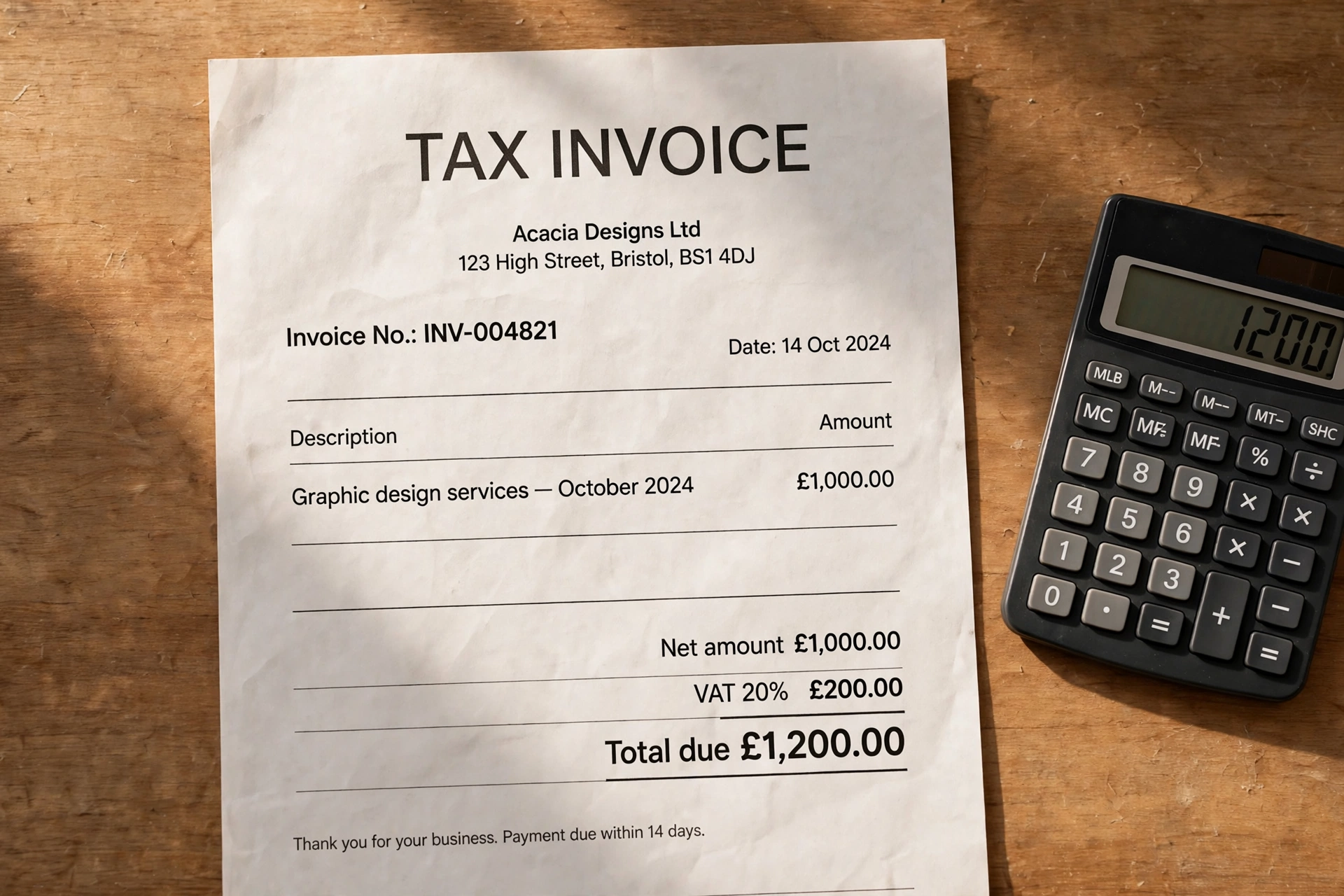
Maya runs a printing business in Leeds. She is VAT-registered. She prints 500 brochures for a marketing agency, which is also VAT-registered. Here is her invoice.
- Design and print, 500 brochures: £1,000.00 (net)
- VAT at 20%: £200.00
- Total due: £1,200.00
The agency pays £1,200. It keeps Maya’s invoice, which shows her VAT number, the £200 of VAT, and the 20% rate. When the agency files its VAT return, it claims the £200 back from HMRC. Maya, meanwhile, pays HMRC the £200 she collected, minus the VAT she paid on her own purchases, like paper and ink.
Nobody is out of pocket on the tax itself. The £200 simply moves along the chain, and this document is the proof at each step. If Maya had sent a plain invoice that only said “Total: £1,200”, the agency could not have claimed the £200, and it would have lost real money.
The same idea works under GST. In India, a supplier selling goods worth ₹50,000 at 18% GST charges ₹9,000 of GST, for a total of ₹59,000. The buyer, if GST-registered, claims the ₹9,000 as input tax credit, using the supplier’s GST invoice that shows the GSTIN and the tax split.
When Do You Need a Tax Invoice?
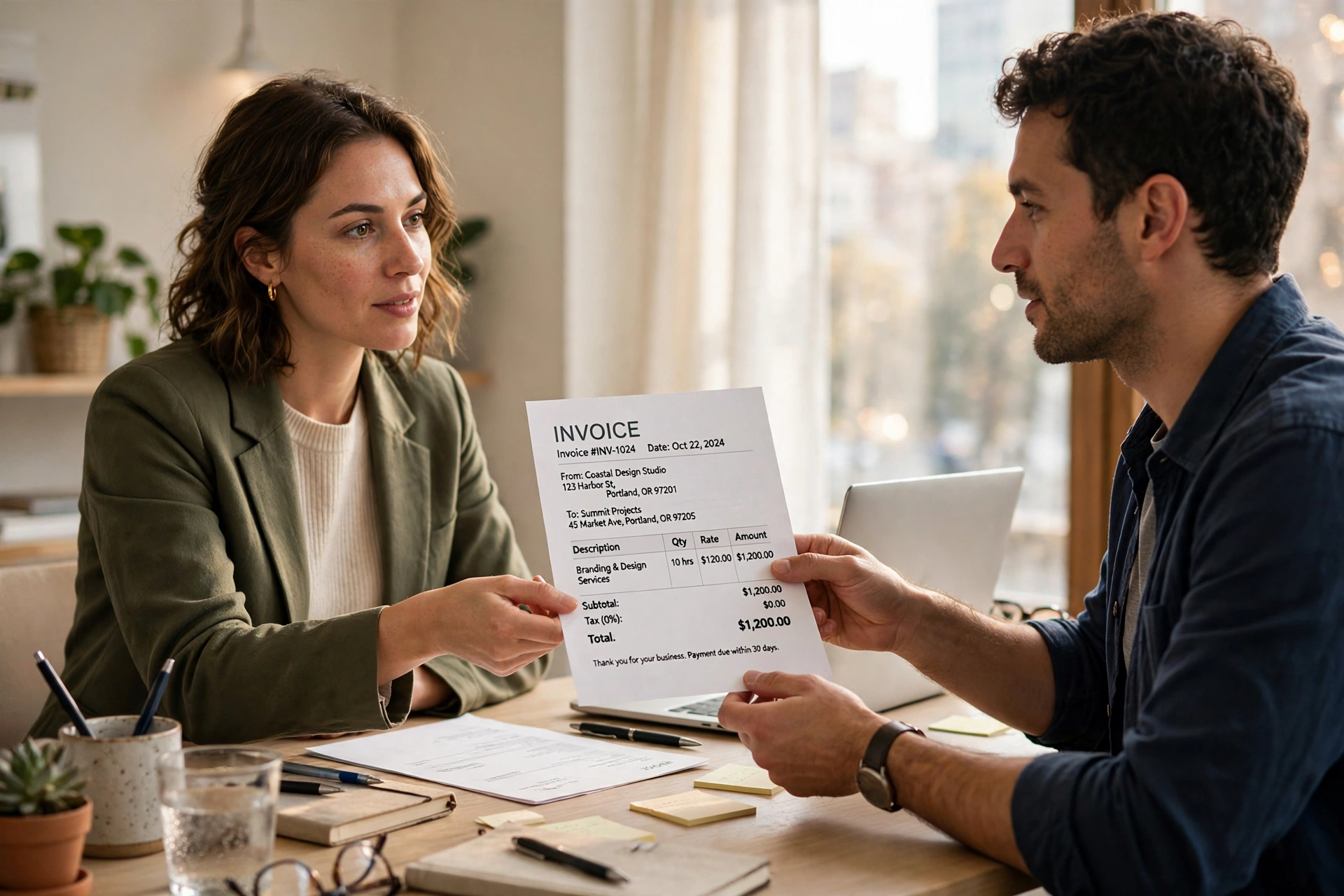
You need to issue one when all three of these are true: you are registered for VAT or GST, you are selling to another business, and that business needs to claim the tax back.
You do not need one when you sell to an ordinary consumer. A shop that sells a laptop to a private customer can give a normal receipt. The customer cannot claim VAT back, so the tax breakdown is not needed — though many shops still show it.
You also do not issue one for sales that are exempt from the tax, or for sales where you charge 0% VAT, like most exports. In those cases the invoice should say why no tax was charged, for example “zero-rated export” or “exempt supply”. A buyer who sees no tax on the invoice and no reason given will ask questions.
And you cannot issue one if you are not registered. This is the rule that catches new businesses out. If your turnover is below the registration threshold and you have not registered voluntarily, you must not add VAT to your invoices, and you must not describe your invoice as one. Charging VAT without being registered is against the law in the UK and in most GST countries, and it can mean fines.
Common Mistakes With Tax Invoices (and How to Fix Them)
Mistake 1: Charging tax when you are not registered.
A new freelancer adds 20% VAT to an invoice because a client asked for a “tax invoice”. The freelancer is not VAT-registered, so the VAT is not real, and the client cannot claim it.
Fix: Only charge VAT or GST after you register. Until then, send a regular invoice with no tax line, and tell the client you are not registered.
Mistake 2: No tax number on the invoice. The invoice shows the tax amount but not the seller’s VAT number or GSTIN. The buyer’s tax authority rejects the claim. Fix: Put your tax number on every invoice, in the same place every time, near your business name and address.
Mistake 3: One total, no tax breakdown.
The invoice says “Total: £1,200” and nothing else. The buyer cannot see how much of that is tax.
Fix: Show the net amount, the rate, the tax amount and the total as four separate lines. Our invoice format guide shows what a good invoice looks like, line by line.
Mistake 4: Wrong rate on one line.
A shop charges 20% on a children’s clothing line that should be 0% in the UK, or applies the wrong GST slab in India.
Fix: Check the rate for each type of product before you invoice. Keep a short list of the rates you actually use, and check it when you add a new product.
Mistake 5: Invoice numbers with gaps.
The seller deletes a draft invoice, so the numbers jump from INV-1041 to INV-1043. Tax authorities read gaps as missing invoices.
Fix: Never delete an issued invoice. If one is wrong, cancel it with a credit note and keep the number in the sequence. See our guide on credit notes for how that works.
Frequently Asked Questions
Is a tax invoice the same as a VAT invoice? In the UK and the EU, yes — a VAT invoice is the local name for this document. In India and Australia, the same document is usually called a GST invoice. The idea is identical: an invoice that proves the tax charged so the buyer can claim it back.
Can I issue a tax invoice if I am not VAT-registered? No. Only a registered business can charge VAT or GST and issue one. If you are below the registration threshold, send a regular invoice with no tax line. You can register voluntarily if your customers need them from you.
Does a tax invoice have to show the tax on every line?
It has to show the tax clearly enough for the buyer to claim it back. The safest way is to show the rate and the tax amount on each line, then a total tax amount for the whole invoice. A single total tax figure with one rate for the whole invoice also works when every line uses the same rate.
What is the difference between a tax invoice and a commercial invoice?
A commercial invoice is for shipping goods across borders. It lists the goods, their value and their origin so customs can charge duty. A tax invoice is for charging VAT or GST on a sale. An export sale can need both: a commercial invoice for customs and a tax invoice (usually zero-rated) for the tax records.
How long should I keep tax invoices?
In the UK, HMRC requires VAT records to be kept for at least 6 years. In India, GST records must be kept for 6 years from the end of the financial year. In Australia, the ATO requires 5 years. Keep digital copies as well as paper ones, and keep them in a place you can find quickly if you are audited.
The Short Version
This document is a normal invoice with the tax shown separately and the seller’s tax number on it. It exists so a registered buyer can claim the tax back. You can only issue one if you are registered for VAT or GST yourself, and it must show the net price, the rate, the tax amount and the total. Get those four lines right, keep your invoice numbers in sequence, and never charge tax you are not registered to charge.
If you need to make one, our free invoice generator builds it in seconds — no sign-up, no watermark, and you can add your VAT or GST number and the tax rate before you download it.
2 thoughts on “What Is a Tax Invoice? VAT, GST & Sales Tax Explained”