
Intro
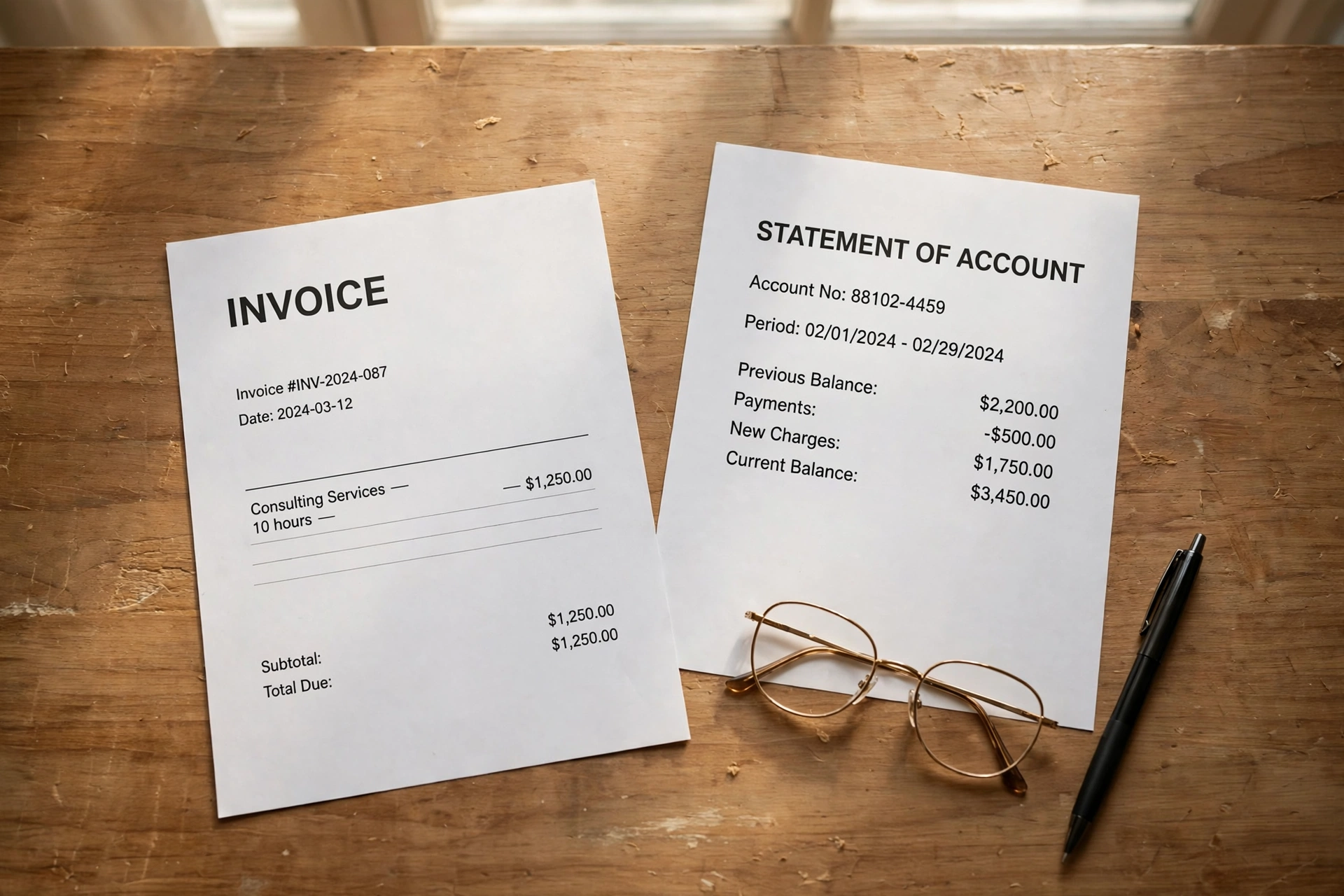
Maya runs a small cleaning business. She sends a client an invoice for $420 after each visit. At the end of the month she also sends a statement that lists all four invoices, the two payments she received, and the $840 still owed. The client rings her and asks: “Do I pay the invoice, or do I pay the statement?” It is the invoice vs statement question in a nutshell.
It is a fair question, because the two documents look alike. Both come from the seller. Both carry money amounts. Both can end with the words “amount due”. But they do different jobs, and mixing them up is one of the most common causes of double payments and missed balances.
This guide explains the invoice vs statement difference in plain words: what each document is, a side-by-side comparison, a worked example with real numbers, when to send each one, and the mistakes to avoid.
What Is an Invoice?
An invoice is a formal request for payment for one specific sale. You send it when you finish a job or deliver goods, and it tells the client exactly what they are paying for, how much, and by when.
A good invoice always has the same parts: your business name and contact details, the client’s name, a unique invoice number, the issue date, a list of what was supplied with quantities and prices, any tax, the total amount due, the payment due date, and how to pay. If you want a full list, see our guide on what to include on an invoice.
An invoice creates a debt. In accounting terms, the moment you issue an invoice you record money owed to you — an accounts receivable. That is why the invoice is the document your client’s accounts team matches against their purchase order and approves for payment. It is also the document that usually counts for tax: in most countries, the invoice is the proof of the sale, and in VAT and GST systems it is the document that lets the buyer reclaim the tax they paid.
You can create a free invoice in seconds with our free invoice generator — no sign-up, no watermark.
What Is a Statement?
A statement — usually called a statement of account — is a summary of everything that happened on one customer’s account over a set period, usually a month. It lists the invoices you sent, the payments you received, any credit notes you issued, and the balance still owed at the end.
A statement does not create a new charge. It only reports what already happened. If a client owes you $1,100, the statement shows how that $1,100 was built up: which invoices, minus which payments, minus which credits. Nothing on a statement is new money — it is a recap.
Statements are normally sent on a fixed cycle, most often monthly. They are useful when a client buys from you again and again: a shop that orders weekly, a café that books your cleaning team every Friday, a client on a monthly retainer. Instead of chasing five separate invoices, the client sees one page with the whole picture and one balance to pay.
Invoice vs Statement: The Differences
Here is the whole comparison in one place.
| Invoice | Statement | |
|---|---|---|
| Main purpose | Ask for payment for one sale | Sum up a whole account over a period |
| Scope | One transaction, one job, one delivery | Many invoices, payments and credits |
| Timing | Sent when the work is done or goods are delivered | Sent on a fixed cycle, usually monthly |
| Detail | Line items, quantities, rates, tax, due date | Dates, document numbers, amounts, running balance |
| Accounting effect | Creates the debt (accounts receivable) | Creates nothing — it only reports existing entries |
| Tax role | Usually the tax document; supports VAT/GST claims | Not normally used for tax records |
| Payment expectation | Pay this amount by this date | Pay the closing balance, or check the open items |
| Legal weight | Proof of the sale and the agreed price | Proof of the account history, useful in a dispute |
The short way to remember it: an invoice says “pay me for this”. A statement says “here is where your account stands”.
Stripe explains the same difference with its own side-by-side breakdown.
Worked Example: One Client, One Month
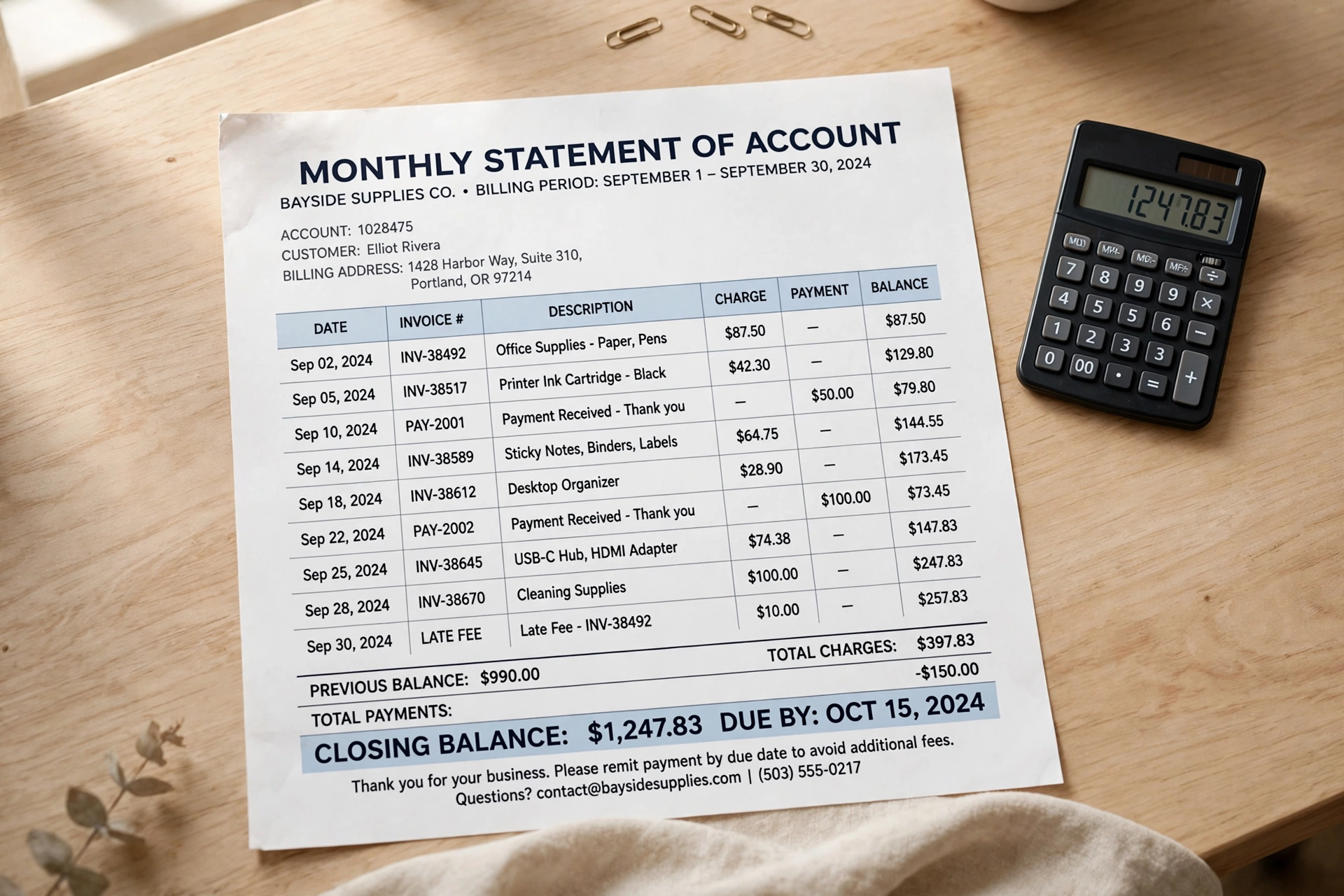
Green Leaf Landscaping looks after the garden at Bloom Café. Here is what happens in May 2026.
First, the invoices. On 5 May, Green Leaf sends invoice INV-1041 for a spring garden clean-up: $850.00. On 18 May, it sends invoice INV-1042 for hedge trimming and new planting: $1,200.00. Each invoice has its own number, its own date, its own list of work, and its own due date.
Then the payment. On 20 May, Bloom Café pays $850.00, which clears INV-1041 in full.
Then a credit. On 22 May, one of the new plants dies, so Green Leaf replaces it free and issues credit note CN-007 for $100.00 against INV-1042.
At the end of May, Green Leaf sends a statement of account for May. It looks like this:
| Date | Document | Details | Amount |
|---|---|---|---|
| 1 May | Opening balance | Nothing owed at the start of May | $0.00 |
| 5 May | Invoice INV-1041 | Spring garden clean-up | $850.00 |
| 18 May | Invoice INV-1042 | Hedge trimming and planting | $1,200.00 |
| 20 May | Payment received | Payment for INV-1041 | -$850.00 |
| 22 May | Credit note CN-007 | Replacement plant, free of charge | -$100.00 |
| 31 May | Closing balance | Amount still owed | $1,100.00 |
Check the maths: $850 + $1,200 = $2,050 in invoices, minus the $850 payment, minus the $100 credit, leaves $1,100. And $1,100 is exactly INV-1042 ($1,200) minus the $100 credit. The statement ties out, line by line.
Notice what the statement does not do. It does not ask for $2,050 — that would double-count the payment and the credit. It does not create a new invoice. It simply shows the client that one invoice ($1,100 after the credit) is still open.
Invoice vs Statement: When to Send Each

Send an invoice every time you finish a job or deliver goods. That is the rule, and it does not change. The invoice is your request for payment, and the client needs it to approve and record the charge. If you only send a statement, many clients will not pay, because their accounts team has nothing to match the payment against. For the wording and timing, our guide on how to send an invoice by email shows four copy-paste templates.
Send a statement at the end of each month to clients who buy from you regularly. It is a gentle nudge that also helps both sides reconcile: the client can spot a missing invoice, an unapplied payment, or a duplicated charge before it becomes an argument. It is also the right document to attach when you chase an unpaid invoice — it shows the whole history, not just one bill.
A good routine for a small business is simple: invoice per job, statement per month, and a reminder when the closing balance passes its due date. If your payment terms say Net 30, your invoice due date does the heavy lifting — see our guide on what Net 30 means — and the statement is the monthly summary that keeps the account clean.
Can a Client Pay From a Statement?
Yes — and this is where most of the confusion lives. A client can pay the closing balance on a statement, and that is often the easiest way for them to settle several invoices at once. But two things must be true.
First, the payment must be matched to the right invoices. If the client pays $1,100 from the example above, you record it against INV-1042 (after the $100 credit), not as a new lump sum with no invoice attached. If you record it against nothing, your books will show INV-1042 as unpaid forever, and you will chase a client who already paid.
Second, the client should still have the invoices. A statement lists invoice numbers and amounts, but it does not list line items. If the client questions a charge — “what was the $1,200 for?” — the answer is on the invoice, not on the statement. Keep both documents, and send the statement with a note like “see attached invoices for detail” if the client is new.
6 Invoice vs Statement Mistakes (and How to Fix Them)
Mistake 1: Sending a statement instead of an invoice
A new freelancer finishes a job and sends a monthly statement as the first bill. The client does not pay, because there is no invoice to approve. Fix: always send the invoice first. The statement comes later, as a summary.
Mistake 2: Paying from the statement without checking the lines
A client pays the closing balance without looking at the lines, and the balance includes an invoice they already paid by card. Fix: before you pay a statement, check each line against your own records. If a line is wrong, ask for a corrected statement or a credit note — do not just pay and argue later.
Mistake 3: Treating a statement as a tax document
A business files its VAT return using a statement because it shows the totals. The tax office asks for the invoices, because only the invoice shows the tax rate, the tax amount, and the seller’s tax number. Fix: keep invoices as your tax records. A statement supports them; it does not replace them.
Mistake 4: Recording the statement as new income
A bookkeeper enters the statement total as a new sale, on top of the invoices already recorded. Now the books show the same sale twice. Fix: a statement creates no accounting entry. Record the invoices when they are issued and the payments when they arrive. The statement is a report, not a transaction.
Mistake 5: No due date anywhere on the statement
A statement lists a balance but no due date, so the client treats it as “pay whenever”. Fix: put the due date of the oldest unpaid invoice on the statement, or add a line: “Balance due within 14 days of this statement”. The invoice due date still rules each line — the statement date is just a reminder.
Mistake 6: Sending statements irregularly
Statements go out in January, then nothing until April. The client cannot reconcile, and small errors grow into big arguments. Fix: pick a cycle — monthly is standard — and stick to it. Even a client with no activity gets a statement that says “balance $0.00”, so both sides know the account is clean.
Invoice vs Statement: Frequently Asked Questions
Is a statement a bill?
Not quite. A statement shows what is owed across an account, and a client can pay from it, but it is not the original bill. The invoice is the bill. Think of the statement as the monthly bank statement for your account with one supplier: useful, accurate, but not the receipt for a single purchase.
Can I send only a statement and skip invoices?
You can, but you should not. Without invoices, your client has no line-item record, no tax document, and nothing to match against a purchase order. Most business clients will ask for the invoices anyway, and you will end up sending them late. Invoice per job, statement per month — that is the routine that works.
Does a statement replace an invoice for tax?
No. In VAT and GST systems, the invoice is the document that proves the sale and lets the buyer reclaim input tax. A statement does not carry the tax breakdown or the seller’s tax registration number in the form the tax office wants. Keep your invoices; use statements only as summaries. For the UK rules, see our UK VAT invoice requirements checklist.
What if the balance on a statement is wrong?
Tell the seller in writing, straight away, and name the exact line that is wrong: the invoice number, the amount, and why it is wrong. Pay the part you agree with, and hold only the disputed amount. Keep copies of everything. Our guide on how to chase an unpaid invoice explains the same habit from the seller’s side — the fix is always the same: point at the exact line, in writing.
How often should I send statements?
Monthly is the standard for most small businesses. Weekly makes sense if a client orders every day. Quarterly is fine for a client you bill twice a year. Whatever you choose, keep it regular — a statement is only useful if the client can rely on it arriving.
Invoice vs Statement: The Short Version
An invoice asks for payment for one sale. A statement sums up a whole account over a month. The invoice creates the debt; the statement only reports it. Send an invoice every time you finish work, send a statement every month to regular clients, and never record a statement as a new sale.
If you need to send the invoice itself, do it in seconds with our free invoice generator — add your details, list the work, and download a professional PDF. No sign-up, no watermark.
2 thoughts on “Invoice vs Statement: What’s the Difference? (With Examples)”