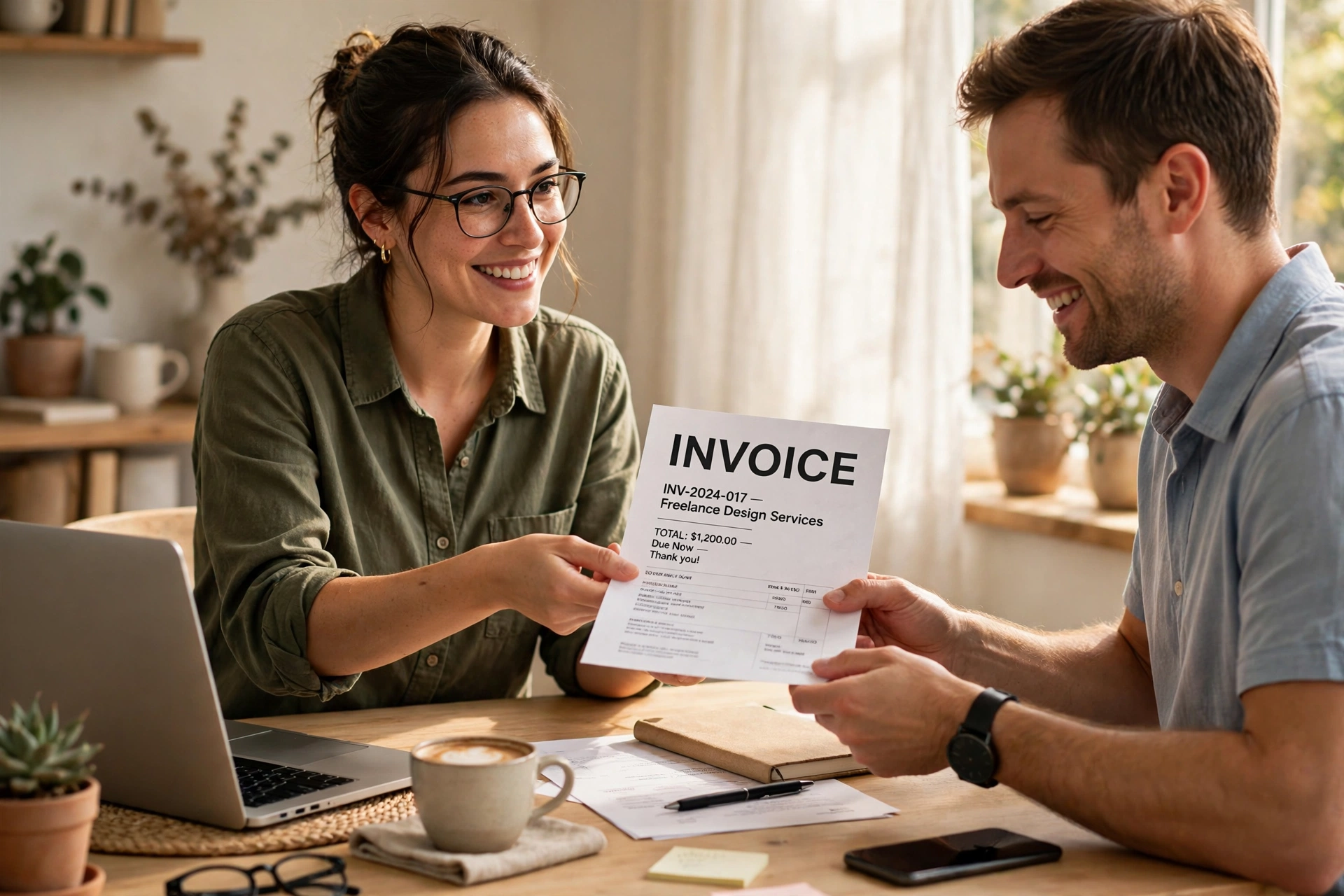
You did a job for someone. A neighbour asked you to fix their fence, a local shop asked you to design a flyer, a friend of a friend paid you to photograph their wedding. The work is done, and now you need to get paid — but you do not have a registered business, no company name, no business bank account. Can you still invoice without a business?
Yes, you can. In most countries, anyone can send an invoice for work they did, whether or not they own a registered business. An invoice is simply a written request for payment. It does not need a company behind it — only the right details, so the person paying you knows who you are, what the payment is for, and how much they owe.
This guide explains how to invoice without a business in plain words: what the law requires, what to put on the invoice, when you need a tax number, how to get paid, and the mistakes that trip individuals up.
The Short Answer: Yes, You Can Invoice Without a Business
You do not need a registered company to send an invoice. A freelancer, a sole trader, a part-time worker, or anyone who did a one-off job can invoice as an individual, using their own name. You can invoice without a business as an individual.
A business is a legal structure. An invoice is a document. The document does not check whether a company exists behind it — it only needs to say who did the work, what the work was, and how much is owed.
That said, “no business needed” does not mean “no rules at all”. Three things still apply. First, you must declare the income — money you earn from invoiced work is income, and in most countries you have to report it and pay tax on it, even if you only did one job all year. Second, your invoice must contain the right details — a vague note saying “you owe me $500” is not a proper invoice. Third, some clients have their own rules — a big company may ask for a tax number or a particular invoice format before they can pay you.
What the Law Actually Requires
The rules differ a little by country, but the pattern is the same almost everywhere: an individual can invoice for work, and the main legal duty is to report the income.
In the United States, you can invoice as an individual using your own name. You do not need an EIN (Employer Identification Number) for a one-person job — your Social Security Number is your tax identifier, but never print it on an invoice. If a client asks for a tax form, they usually mean a W-9, which you fill in privately. The IRS guidance for self-employed people explains how this income is reported.
In the United Kingdom, you can invoice as a sole trader using your own name. You do not need to register a company, but you do need to register as self-employed with HMRC if you earn over £1,000 in a tax year from self-employment, and report it through a Self Assessment tax return. The GOV.UK page on how to set up as a sole trader walks through the steps.
In Canada, Australia, and most of Europe, the same idea holds: individuals can invoice for services, and the tax office cares about the income being declared.
What Every Invoice Must Include
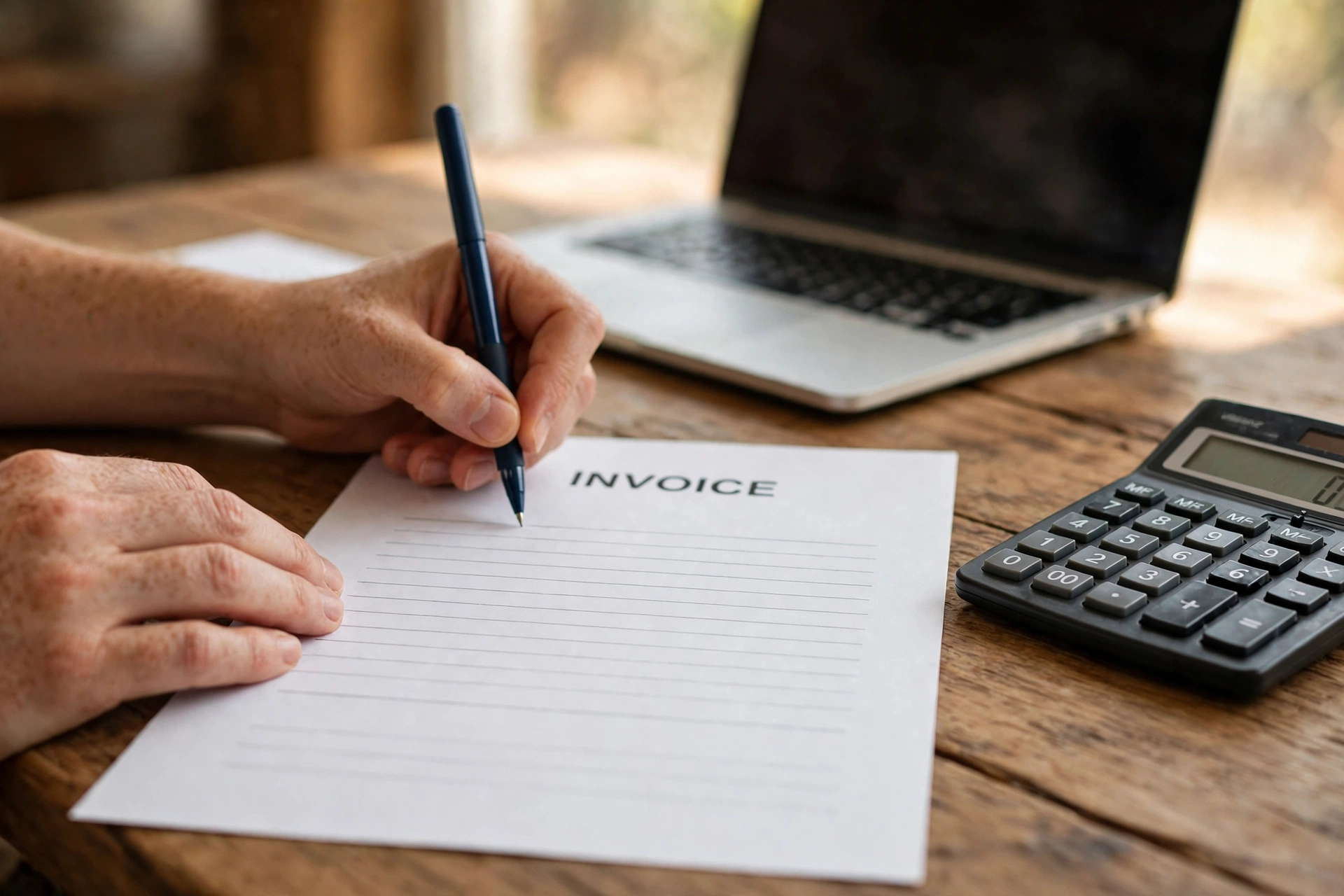
A proper invoice has ten parts. Miss one and the client may delay payment while they ask questions. Get them all right and the invoice can be paid the same day. If you want the full detail on each part, read our guide on what to include on an invoice — here is the short version for individuals:
- Your name and contact details. Full name, address, phone number, and email — spelled exactly as on your bank account.
- The word “Invoice”. The document must clearly say it is an invoice, not a quote or a receipt.
- A unique invoice number. Start at 001 or use a system like INV-2026-001. Every invoice gets a new number, never repeated. A clear invoice numbering system saves confusion later.
- The invoice date and the due date. The date you sent it, and the date the money is due. “Due on receipt” or “Net 14” (14 days) are both fine — just state it plainly.
- Your client’s name and address. Who owes the money.
- A description of the work. What you did, in plain words, with quantity and rate. “Fence repair, 6 hours at $40 per hour” beats “Services rendered”.
- The total amount. Subtotal, any tax (usually none if you are not tax-registered), and the final total, clearly shown.
- How to pay. Your bank details, or the payment app you use. Make paying easy — every extra step is a reason to delay.
- Your payment terms. Any late fee or early-payment note, if you use them. Keep it short and fair.
- A thank-you line. One sentence is enough.
A free invoice generator builds all of this for you in a minute — type in the details and download the PDF. You do not need to design anything yourself.
A Worked Example: Invoicing as an Individual
Here is what an individual’s invoice looks like in practice. Daniel is a handyman. He has no registered business. A local cafe asks him to repair a broken fence panel and repaint a door. He agrees on $40 per hour, and the job takes 8 hours. He also buys $85 of paint and screws, which the cafe agreed to pay for.
Daniel’s invoice looks like this:
| Line | Detail | Amount |
|---|---|---|
| Fence repair and door painting | 8 hours at $40 per hour | $320.00 |
| Paint and screws (materials) | As agreed, receipts attached | $85.00 |
| Total due | $405.00 |
The invoice is headed “INVOICE — INV-2026-001”, dated 4 November 2026, due 18 November 2026 (Net 14). At the top: “Daniel Smith, 12 Oak Street, Springfield — daniel.smith@email.com — (555) 014-8820”. The client is “The Corner Cafe, 44 Main Street”. At the bottom: “Payment by bank transfer to the account below. Thank you for your business.”
That is a complete, professional invoice. No company name, no registration number, no tax number — and nothing missing. The cafe’s bookkeeper can file it and pay it, and Daniel can record the $405 as income and declare it at tax time.
Do You Need a Tax Number on the Invoice?
If you are not registered for VAT, GST, or sales tax, you do not put a tax number on the invoice. There is nothing to put. Your invoice simply shows the total with no tax line, and that is correct. Do not invent a number, and do not copy someone else’s.
If a client asks for your tax ID, give it to them privately, not on the invoice. In the US, a client may ask you to complete a W-9 form so they can report what they paid you. That form carries your Social Security Number or EIN and goes to their accounts team directly — never printed on an invoice that might be forwarded. In the UK, a client may ask for your Unique Taxpayer Reference (UTR), and the same rule applies: share it directly, not on the invoice face.
If you are VAT-registered, the rules change. Once you register for VAT, your invoices must show your VAT number, the VAT rate, and the VAT amount. That only applies after you register — a choice, or a duty once you pass the £90,000 threshold in the UK. The one number that always belongs on your invoice is your own invoice number — that is what you and the client use to track the payment.
How to Get Paid Without a Business Bank Account
You do not need a business bank account to receive payment for an invoice.
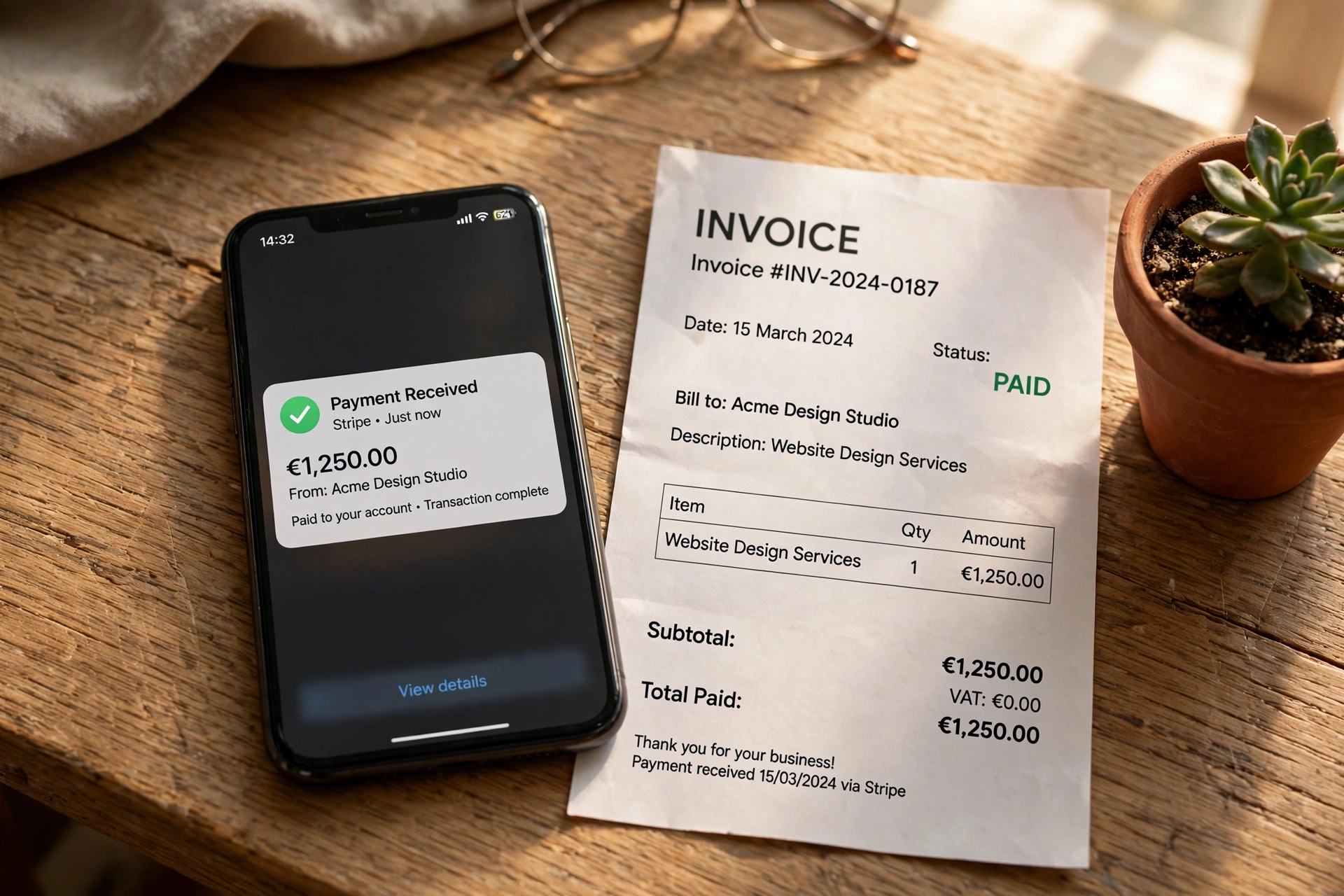
Three things are worth doing. First, put your bank details on the invoice — name, account number, and sort code or routing number, whatever your country uses. Double-check every digit before you send it: one wrong digit can send the payment to a stranger. Second, offer a second payment option — a payment link or a card payment app gives the client a one-click way to pay, though apps take a small fee, so check it before you promise a price. Third, open a separate account when the work becomes regular — a second account in your own name keeps your business money apart from your household money and makes tax time far easier.
One habit matters from the very first invoice: chase late payments politely but firmly. A short payment reminder a few days after the due date gets most invoices paid. If a client is weeks late, a clear plan for chasing an unpaid invoice — a reminder, then a firmer note, then a final notice — works far better than silence.
5 Mistakes Individuals Make When Invoicing (and How to Fix Them)
- Sending an invoice with no number. Without a number, neither you nor your client can tell two invoices apart. Fix: number every invoice, in order, from the very first one.
- Writing a vague description. “Work done” tells the client nothing, and their accounts team will ask questions instead of paying. Fix: describe the work, the hours, and the rate, in one plain sentence per line.
- Forgetting the due date. No due date means no deadline, and the invoice sits at the bottom of a pile. Fix: always state a due date. “Due 18 November 2026” is clear. “Pay soon” is not.
- Hiding the payment details. If the client has to email you to ask how to pay, you have added a delay for no reason. Fix: put the bank details or payment link on the invoice itself, under the total.
- Not keeping a copy. Individuals often send the invoice and delete it, then cannot prove what they earned at tax time. Fix: save every invoice as a PDF in one folder, and keep a simple list — number, client, date, amount, paid or not.
When Should You Register a Business?
Invoicing as an individual is the right start, but there comes a point when registering makes sense:
- The work is now your main income. If invoicing is no longer a side job but how you earn your living, registering as a sole trader (or the equivalent where you live) gives you a proper tax setup and a clearer boundary between work and personal life.
- You pass a tax threshold. In the UK, earning over £1,000 from self-employment in a tax year means you must register as self-employed. In the US, earning over $400 in net self-employment income means you must file and pay self-employment tax. Check your own country’s threshold — it is usually lower than people think.
- You want protection, or clients ask for it. A registered company separates your personal money from your business debts, and some large companies only work with registered suppliers. If either applies, registration is worth the small effort.
- You hire someone. The moment you pay another person to help you, you are an employer, and that needs a registered setup.
Registering is not hard — in the UK it takes minutes online, and in the US it is a simple form with your state. But do not rush it. Start as an individual, invoice properly, declare the income, and register when the work justifies it.
Frequently Asked Questions
Can I send an invoice if I am not self-employed?
Yes, for a one-off job. You can invoice as an individual for a single piece of work, but you still need to declare the income. If the work becomes regular, register as self-employed — the threshold is usually low.
Do I need to charge tax on my invoice?
Not unless you are registered for that tax. If you are not VAT-registered, GST-registered, or collecting sales tax, your invoice shows no tax line and the total is the full amount.
Can I invoice a company as an individual?
Yes. Companies pay individuals all the time — freelancers, contractors, and one-off workers. They may ask for a tax form (like a W-9 in the US) for their records, but that does not stop you invoicing. Give them the form privately.
Do I need a business bank account to get paid?
No. At the start, your personal account works fine — the money arrives the same way. Open a separate account once invoicing becomes regular, so your business money stays apart from your household money and tax time is easier.
Do I need a business name to look professional?
No. Your own name, presented well, is professional. What looks unprofessional is a sloppy invoice — no number, no date, no description, no payment details.
Start With Your First Invoice Today
You do not need a company, a business bank account, or a tax number to send your first invoice. You need your name, the client’s name, a number, a date, a clear description, a total, and a way to be paid.
If you are ready to send one, a free invoice generator will lay it out for you in under a minute — no sign-up, no watermark, and you can download it as a PDF straight away.
1 thought on “Can You Invoice Without a Business? Rules for Individuals & Sole Traders”